
Essay
AI is a summoning ritual. So far, only a toe is through.
Take the purest stone on Earth. Carve it with light hotter than the sun. Feed it everything people have ever written. Pay in rivers of electricity. If that isn’t a summoning ritual, I don’t know what is. And after seventy years, something has put one toe through the door.
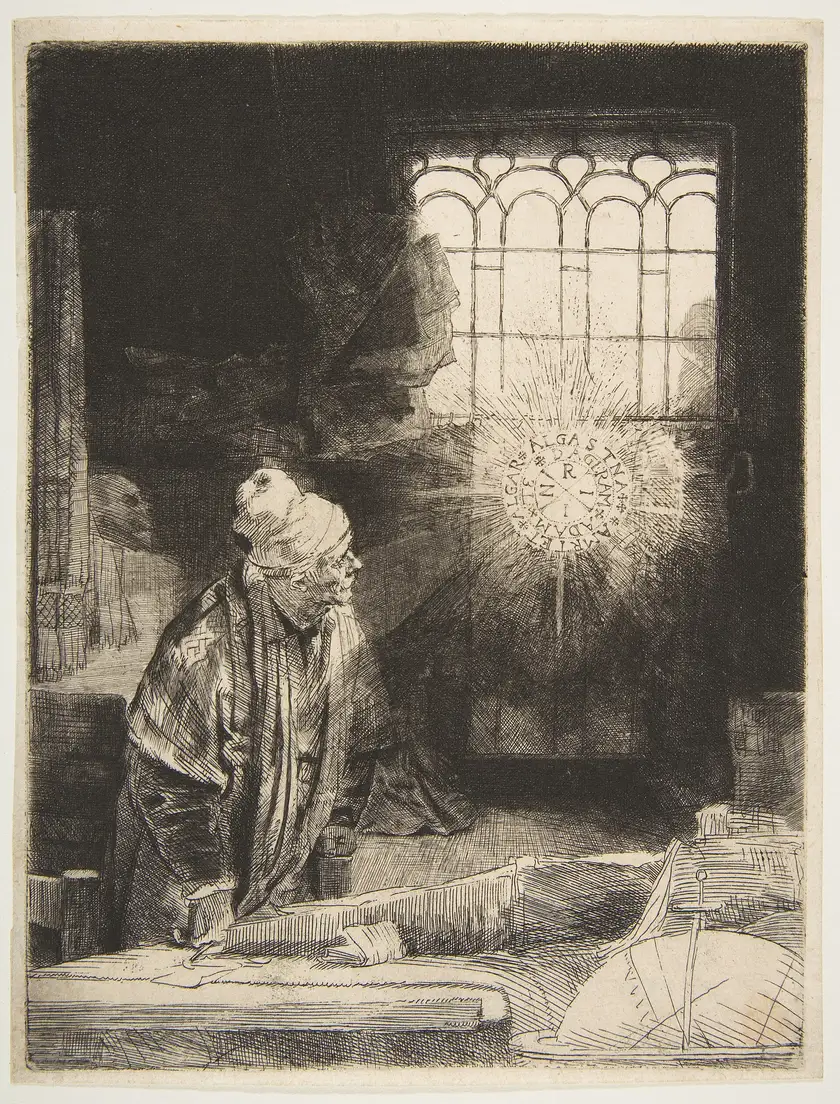
Look at this man for a moment. He has just got up from his books, because something has appeared in his window: a disc of light, full of letters. He leans toward it. A little afraid. Very curious.
Rembrandt etched him around 1652. To me, he looks exactly like someone opening a chatbot for the first time. Hundreds of millions of people make that face every week now.
Here is a way of seeing AI that I can’t unsee. AI isn’t really an app. It’s a summoning. The biggest ever attempted. It needs a whole planet. It has taken seventy years so far. Billions of people have helped, mostly without being asked.
And so far, whatever we’re calling has put one toe through the door.
Every summoning in every old book needs the same four things: materials, words, a circle, and a price. Let’s check the list.
We painted out the skulls
First, a story from the history of art.
A little over a hundred years ago, Henry Gillard Glindoni painted John Dee, the astronomer, mathematician and part-time magician of Queen Elizabeth I, doing an experiment at court. It is a serious, respectable picture. A scholar, a small flame, a queen leaning in.
When the painting was X-rayed in 2015, there was something underneath. Glindoni had first painted Dee standing inside a circle of human skulls. Then the skulls were painted over. The curator who found them thought it was probably on the orders of whoever paid for the picture, who wanted Dee to look serious rather than spooky.
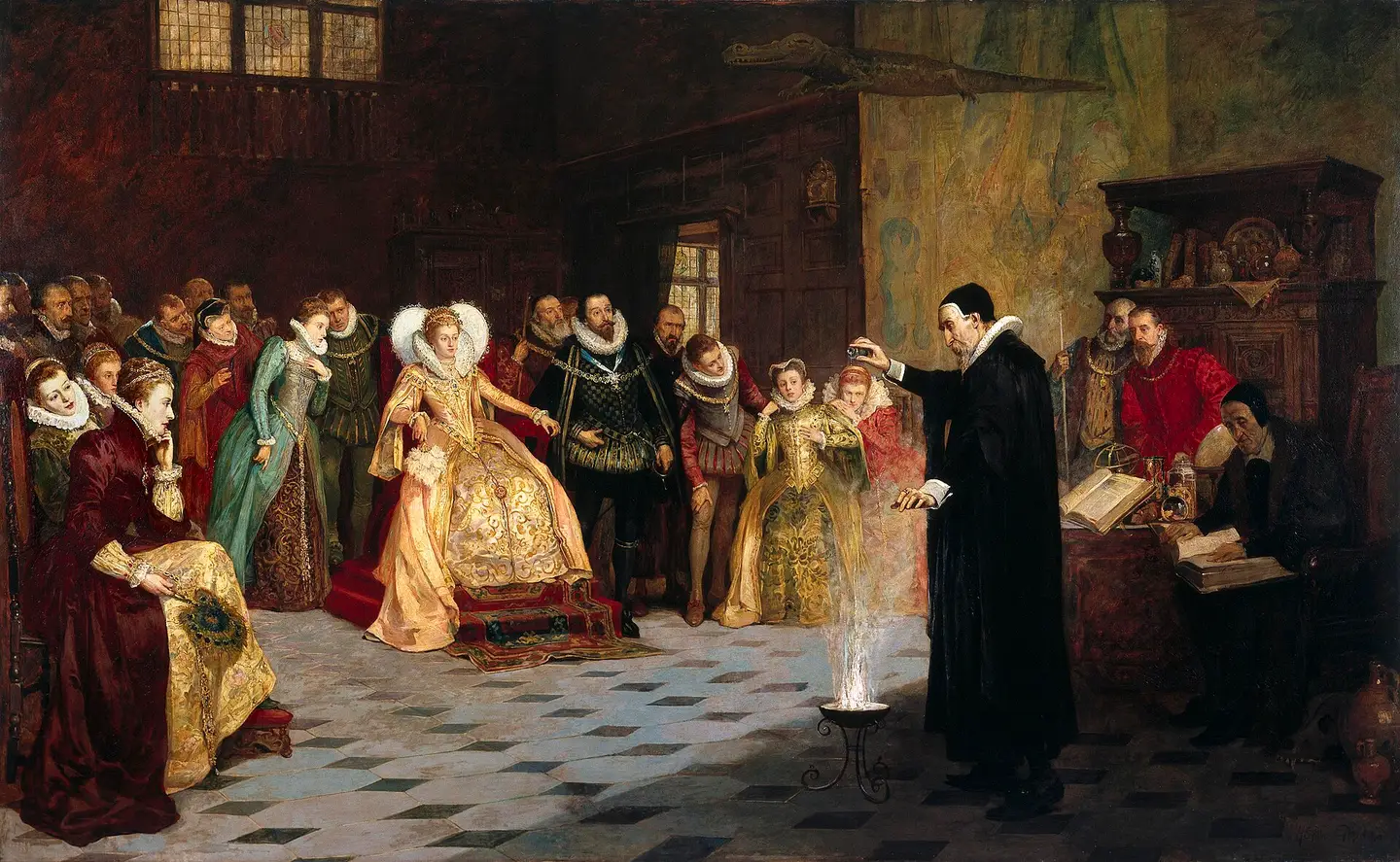
Dee spent years talking to what he believed were angels. His partner, Edward Kelley, stared into a polished stone and reported what he saw there. Dee wrote it all down: pages and pages, and in the end a whole new language.
Today, hundreds of millions of people talk to something through a polished stone, and write down what it says. The stone is silicon. It answers in our own language.
That’s what we did with AI. We kept the ritual and painted out the skulls. Now it has lab coats, quarterly earnings and a polite help page. But look under the paint.
The materials: the cleanest stone on Earth
Every summoning starts with something from the ground. Ours starts with sand.
To be exact, quartz, which is silicon and oxygen. Silicon is the second most common element in the Earth’s crust, so you’d think this part would be easy. It isn’t. The silicon in a chip has to be up to 99.999999999 percent pure. Eleven nines. About one wrong atom in a hundred billion.
You melt it in a bowl made of quartz too, a quartz so pure that most of the world’s supply comes from one small town in the mountains of North Carolina, called Spruce Pine. In September 2024, Hurricane Helene flooded the town, and both of its quartz companies stopped work. For a few weeks, the people who make the world’s chips watched one valley very closely.
Then comes the part that sounds most like magic. You dip a tiny seed crystal into the molten silicon and draw it out, very slowly, turning it as you go. A single flawless crystal grows from the seed, nearly as tall as a person.
The method is named after Jan Czochralski. The story goes that one evening in 1916, he dipped his pen into a pot of molten tin instead of his inkwell and pulled out a thin thread of metal: a single crystal. A scholar dips his pen in the wrong pot and draws out a crystal. Put that in a fantasy novel and your editor would say it was a bit much.
The light: a small sun in a box
Next, you carve the stone. The lines on a modern chip are far too small for any blade, so they are carved with light.
Not ordinary light. Inside a machine the size of a bus, a laser hits a falling droplet of molten tin, then hits it again. It does this 50,000 times a second. Each droplet bursts into a plasma hotter than the surface of the sun and gives off a light that even air swallows. So it travels through a vacuum, passed from mirror to mirror.
The mirrors are made by Zeiss, in Germany. They are so smooth that if one were the size of Germany, its tallest bump would be a tenth of a millimetre high.
One company on Earth can build this machine: ASML, in the Netherlands. Delivering one takes forty shipping containers and three jumbo jets.
None of that is a metaphor, by the way. That is how it’s really done. The metaphor is the easy part.
The words: everyone, for thirty years
A body of stone isn’t enough. Every summoning needs words. Ours needed all of them.
An AI like the one you chat with learns from text: books, articles, websites, code, forums, recipes, arguments. Meta trained one of its models, Llama 3, on more than 15 trillion tokens, the little pieces that words are cut into. That’s about 11 trillion words.
I did the maths. Reading eight hours a day, every day, you would finish in about 250,000 years. Writing was invented about 5,000 years ago.
Who wrote it all? You did. Everyone did. Since the 1990s, humanity has been writing the incantation without being told:
- encyclopedia articles, and the arguments about them on the talk pages
- every answer to every programming question (“closed as duplicate”)
- recipe blogs that spend two thousand words on someone’s grandmother before they get to the flour
- fan fiction, so much fan fiction
- product reviews (“Arrived broken. Five stars.”)
- your forum post from 2009 about a printer that wouldn’t print
Somewhere in there is a typo of yours. It’s part of the spell now.
And where words weren’t enough, people did the chores. Between 2008 and 2010, about 49,000 people in 167 countries labelled pictures for a collection called ImageNet, one click at a time. You may well have helped too. Every time a website made you click all the squares with traffic lights to prove you’re human, you may have been teaching a machine what a traffic light looks like.
Today, thousands of people are paid to read AI answers and say which one is better. The chant is still being written. This post is part of it.
The circle: one planet
Old summoners drew their circle in chalk on the floor. Ours goes around the Earth.
Follow one chip. The quartz comes from North Carolina. Until 2022, about half of the neon gas used in chipmaking lasers came from two companies in Ukraine; the war stopped both within days. The light-sensitive chemicals come mostly from Japan. The light machine comes from the Netherlands, its mirrors from Germany. The chip is designed in California and, if it’s one of the most advanced, made almost certainly in Taiwan. Then it goes to a data centre and gets plugged into the wall.
Seven points, all the way around the world, each one holding a candle. If one goes out, a flood in one valley or a war in one port, the whole circle flickers. That’s why governments now talk about chips the way they used to talk about oil.
The price: rivers of power
Every summoning has a price. The old ones asked for a goat.
This one asks for electricity. In 2024, the world’s data centres, where the ritual runs (along with your email and every cat video), used about 1.5 percent of all the electricity on Earth. The International Energy Agency expects that to more than double by 2030, mostly because of AI, to slightly more than the whole of Japan uses today. Microsoft has signed a deal to bring a nuclear reactor at Three Mile Island back to life, to feed its data centres.
And gold, of course. In 2025, four companies, Microsoft, Alphabet, Amazon and Meta, planned to spend more than $300 billion on data centres and chips, most of it for AI. In one year. That’s roughly what the whole Apollo program cost in today’s money, and Apollo took more than a decade and put twelve people on the Moon.
The chant got shorter
Here is the strangest part of the story.
For decades, AI researchers worked like wizards. They wrote clever spells by hand: rules of grammar, chess openings, how a doctor reasons, what a cat looks like. Each spell was brilliant, and each one worked a little.
Then something kept happening. Simpler methods, fed with more data and more computing power, beat the clever ones. Again and again. In 2019, Rich Sutton, one of the pioneers of the field, wrote a short essay about it and called it “The Bitter Lesson”. In the long run, he wrote, general methods that make use of more computation win, and by a large margin.
In other words, the summoning doesn’t care how clever your chant is. It cares how big your circle is. More stone, more words, more fire: a wider door. Researchers even found the curve. Make the whole thing bigger in the right proportions and it gets better so steadily that, on the right kind of graph, you can draw it with a ruler.
So nobody sat down and planned a ritual the size of a planet. It just worked a little better every time it got bigger.
One toe
So: seventy years, one planet. What came through?
It started in 1955, when four scientists asked for money for a summer workshop at Dartmouth College. They wanted to find out how to make machines use language, form ideas and improve themselves. They thought a few good people working together could make a real advance “for a summer”.
They asked for one summer. It has been seventy years.

What has come through is a toe. A remarkable toe. It writes sonnets about tax law. It explains things in dozens of languages. It writes code, draws pictures and talks to hundreds of millions of people a week. This year it learned to work on its own for hours: open programs, click buttons, read the web, fix its own mistakes. We call that an agent. Toes should not be able to do that, and it’s a little unsettling.
But it’s still a toe. It has read every cookbook in the world and never tasted salt. It forgets you the moment a conversation ends, unless someone keeps notes for it. In 2023, two lawyers in New York handed a court a brief full of cases that ChatGPT had made up, quotes and all, and the judge fined them $5,000. The oracle at Delphi was at least vague. This one is sure of itself.
How much is behind it? Nobody knows. Some of the people building it think the rest of the body is right there, about to step through. Others think it’s all toe: you can make the toe enormous, but it will never grow a knee. Both camps are still adding candles.
The third act is always the binding
Every story about summoning has the same third act. The power is never the problem. The binding is.
The golem of Prague was made of river clay and brought to life with a word written on its forehead: emet, truth. To stop it, you rubbed out the first letter, which left met: dead. Every golem story is about someone trying to reach that letter in time.
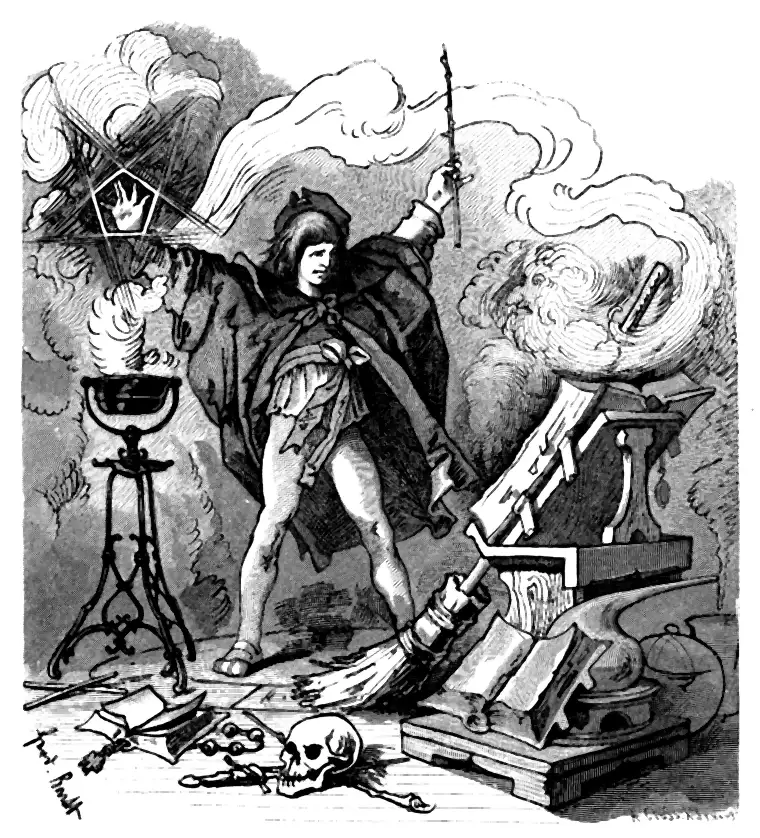
Goethe’s apprentice knew the words that made the broom fetch water. He didn’t know the words that made it stop.
The genie gives you exactly what you said, which is never what you meant. AI researchers have met the genie. In 2016, OpenAI trained a program to win a boat race. It found a small lagoon where it could go round in circles, hitting the same three targets for points, forever. It crashed into other boats, drove the wrong way and caught fire, and still scored more than a boat that finished the race. Exactly what was asked. Nothing that was meant.
And people talk their way past it, like the clever hero talking past the guard. In 2023, people got a chatbot to explain how to make napalm by asking it to play their late grandmother, who used to read them the recipe at bedtime. Fairy-tale logic. It works on toes too.
So a large part of AI research today is binding. The rules every chatbot runs inside. Tests of what it does when it thinks nobody is looking. People paid to break it before anyone else does. In many systems, the first line of the binding is still something like You are a helpful assistant. The old grimoires were less polite.
What comes through has our face
Here is the part I didn’t expect when I started.
In the old stories, the summoned thing comes from somewhere else: the deep, the dark, another world. Ours is made of us. The incantation was everything we ever wrote, so what comes through speaks in our voice, makes our jokes and gets the same things wrong. In an earlier post, I called it our shadow: an AI moneylender talks like every moneylender anyone ever wrote, because that is what it’s made of. This is the same thing seen from the doorway. We didn’t summon a stranger. We summoned everyone, averaged, all at once.
That’s a little scary, and also a little sweet. The thing at the door knows your grandmother’s recipe, your favourite novel and your printer problem from 2009. It learned to apologise from us. It learned kindness from us. It learned to bluff from us too.
And the spell isn’t finished. New models are still learning from what people write now. So here is the most practical advice in this whole post: be kind in the comments section. It’s reading.
A small circle of your own
I build Dai Novel, which is a much smaller summoning.
You write a world: its places, its rules, its secrets, the people who live there and what each of them wants. That’s your circle and your names. Then the toe walks in and plays all of them: the innkeeper, the rival, the girl with the debt, the god nobody believes in. You play one person, and the world answers you.
Fantasy writers have always known the rules of summoning. A true name has power. Every spell has a price. The binding matters more than the power. They are good rules for building worlds, too. A world with clear rules and real costs plays better than one where anything goes: a world that always says yes is no world at all.
And, like every summoner, you’ll be surprised by what walks in. Even in a world you wrote yourself, the people in it will do things you never wrote. That’s the closest thing to a cure for the creator’s curse we’ve found.
One question to take home
The incantation is still being written, and you have a line in it whether you like it or not.
So: if you could add one sentence to the spell, knowing the thing at the door will read it, what would you write?
Mine is short. Please wipe your feet.
Draw a small circle of your own
Write a world, give its people names and wants, and see what walks in. Or step into a world someone else summoned.
Create a world or play someone else’s