
Essay
The creator’s curse: the one world you can’t see for the first time.
You can build a world for years. You can know every road in it, every lie, every grave. But there is one thing you can never do there: arrive.
Think of a world you have been building in your head. Maybe for a week, maybe for ten years.
You know what the hero wants, and what she is afraid to say. You know who is lying, and why. You know what is under the castle, and the day it will come out. You know how it ends.
Now try to read it as a stranger would. Try to meet your villain without knowing he is the villain.
You can’t. Nobody can.
I call this the creator’s curse: the better you know your world, the less you can see it fresh. Every secret you plant is a surprise you will never get.
Here is the short version:
- A creator knows everything, so nothing in their world can surprise them.
- Psychologists call this the curse of knowledge. There is a famous experiment about it, with songs tapped on a table.
- It is the same reason you can’t tickle yourself.
- It makes creators bad judges of their own work. Worse, it takes away the best part: the first time.
- Creators fight back with time, fresh eyes, and less planning.
- An interactive world can do something a novel can’t: surprise the person who made it. Not completely. But more than a book ever could.
Two people meet the same old man
Let’s use a world from an earlier post: a sword-and-magic kingdom built over the body of a sealed Demon King. Every crystal of mana in the land is mined from him. The church says he is dreaming. The guild says the rock is settling.
Say you are the author, and you decide the truth. The guild master knows the Demon King is waking up. He has known for ten years. He keeps the mines open anyway, because the crown pays him to.
Now a player arrives, playing the lowest-ranked adventurer in the guild: a girl who scrapes shards off the first floor to pay for her brother’s medicine. In the first scene, the guild master, a tired old man, sells her a healing potion at half price. He tells her to stay on the first floor.
Two people read that same scene:
- The player meets a kind old man. Maybe the only kind person in the city. They like him. They might trust him with their life.
- You meet a liar. You know why he wants her on the first floor. You know what the cheap potion is paying for. Every kind word is a cover.
The player gets a kind old man, and later, a betrayal that really hurts. You get neither. You can never meet the kind old man, because you made him a liar before he said a word.
The song only you can hear
In 1990, a Stanford psychology student named Elizabeth Newton ran a simple experiment. She put people in pairs. One was the tapper. The other was the listener.
The tapper picked a well-known song, like “Happy Birthday”, and tapped its rhythm on a table. The listener had to name the song.
Before they started, the tappers guessed how often the listeners would get it right. They said about half the time.
Over the whole study, 120 songs were tapped. The listeners named three. That is one in forty.
Why were they so far off? Because the tapper hears the song. While they tap, the melody plays in their head, words and all. The listener hears none of that. The listener hears a person knocking on a table.
And the tapper can’t turn the song off. They can’t imagine what the knocking sounds like without it.
Economists had already given this a name, in 1989: the curse of knowledge. Once you know something, it is very hard to imagine not knowing it.
A creator is a tapper. You hear the whole song of your world: the history, the secrets, the ending. Your reader hears knocks: the words on the page, and nothing more.
Why you can’t tickle yourself
Try it. Tickle the palm of your own hand. It doesn’t work.
In the late 1990s, Sarah-Jayne Blakemore and her colleagues in London found out why. Your brain predicts what your own fingers will feel, and turns the feeling down. A touch you planned is a touch you already expected.
Then they tried something clever. People tickled their own hand through a robot arm, and the robot added a tiny delay, a fraction of a second. The longer the delay, the more ticklish it felt. The brain’s prediction no longer matched, so the feeling came back.
Stories work the same way. A surprise is the gap between what you expected and what happened. A creator expects everything, so there is no gap.
That is why:
- You can’t scare yourself with your own ghost story.
- You can’t solve your own mystery.
- You can’t gasp at your own twist.
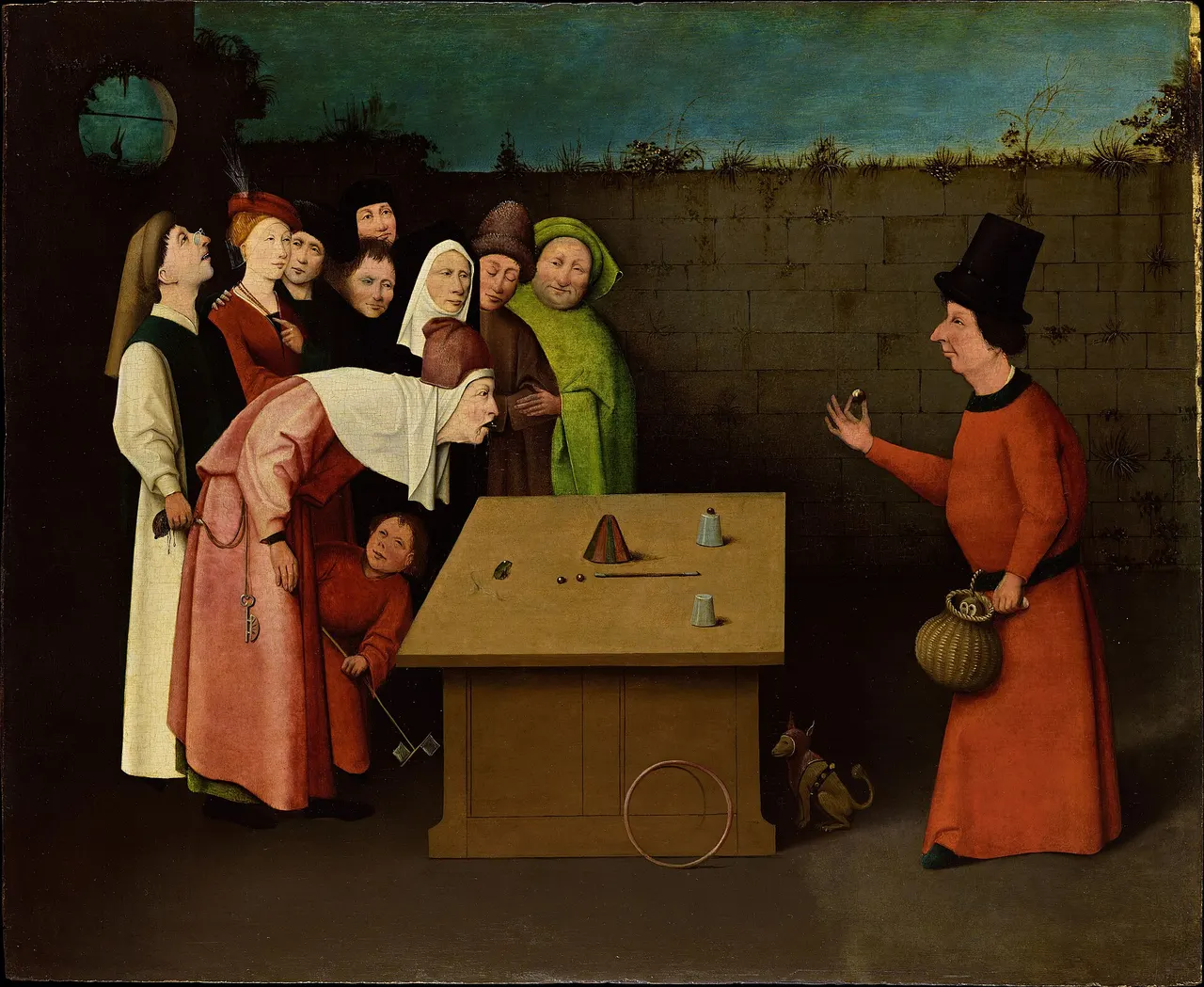
Magicians know this well. Look at the painting below. Everyone at the table is watching a miracle. Only one person isn’t amazed: the man who made it.
What the curse costs you
The curse doesn’t only take away surprises. It also makes creators bad judges of their own work. Here is how it usually shows up:
- You can’t judge your own twist. Is it too obvious? Too hidden? You can’t tell. You see every clue, because you put it there.
- You leave out things that matter. Who is this man? Why does she hate the church? It’s obvious to you, so it never reaches the page. The reader is listening to knocks.
- Or you explain too much. You’re afraid nobody will get it, so you say it three times.
- You can’t feel your own pace. A slow first chapter feels full to you, because you know what every detail is for. A stranger only feels that it’s slow.
- You think the world is richer than the page. Your notes hold three hundred years of history. The reader gets the twelve lines you actually wrote.
Even typos follow this rule. You can read your own sentence five times and not see the missing word. Your brain reads what you meant, not what is there.
Game designers see this all the time. Chet Faliszek, a writer at Valve (Portal, Left 4 Dead), has described what happens when designers watch strangers play their game for the first time. At first they think the testers are idiots. The players walk past the obvious door. They miss the clue. After the third or fourth group, the designers finally see it: “It’s not their fault, it’s our fault.”
The door was only obvious to the people who built it.
The part you lose is the best part
But the deepest cost isn’t about quality. It’s about joy.
Think about the first time you fell into a world you loved. Not knowing who to trust. The twist that made you go back and read chapter one again. The night you stayed up because you had to know.
That feeling is why many of us start making worlds. We want to give it to someone else. Or we want to feel it again.
And here is the cruel part: building a world is the one sure way to never feel it there. You made the moment, so it can’t happen to you.
It’s like planning a surprise party. You get a lot of joy from it: the plan, the secret, your friend’s face when the lights come on. But you don’t get the surprise. The surprise belongs to the guest.
You build the door. Only a stranger gets to open it.
What you get instead
To be fair, the curse comes with a gift.
Vladimir Nabokov told his students that you can’t really read a book. You can only reread it. The first time, you are busy finding out what happens. The second time, you start to see how it was made.
A creator lives in the reread. You know why every detail is there. You see what no reader ever will: why the river bends, the old grudge behind a joke, the scene you cut that still shapes the scenes you kept.
Researchers have also asked whether spoilers ruin stories. A 2011 study at UC San Diego found that people enjoyed some short stories a little more when they knew the ending first. Later studies didn’t all agree. Either way, a spoiled reader only knows the ending. You know the whole machine.
So you don’t lose your world. You lose one way of having it: the first time.
How creators fight back
Nobody has a cure. But creators have found a few good tricks.
1. Forget on purpose
Stephen King, in his book On Writing, says to put a finished draft away for about six weeks and not look at it. When you take it out again, it should feel a little strange, almost as if someone else wrote it.
You can’t forget your world. But you can forget your sentences, and read them almost like a stranger would.
2. Borrow fresh eyes
If you can’t be a stranger, find one. Writers have beta readers. Game studios run playtests: they put a new player in front of the game and watch.
The hard rule is: don’t explain. The moment you say “oh, you’re supposed to go left”, the test is over. You have hummed the song.
And fresh eyes run out. Some game studios call first-time testers Kleenex testers: like a tissue, each one can only be used once. After one play, they know too much as well. The curse spreads.
3. Don’t plan everything
George R.R. Martin says there are two kinds of writers. Architects plan everything before they build. Gardeners plant a seed and see what grows.
Gardeners keep a little of the first time for themselves. Even Tolkien, who planned his world for decades, didn’t plan everything. When his hobbits reached the inn at Bree, a stranger was sitting in the corner. Years later, Tolkien wrote that Strider was a shock to him: “I had no more idea who he was than Frodo did.”
For a few pages, the creator was a first-time visitor in his own world.
Many writers say this happens to them. In 2003, the psychologist Marjorie Taylor and her colleagues interviewed 50 fiction writers. 92 percent said their characters sometimes seemed to speak or act on their own.
But even a gardener only gets this once. When the book is done, Tolkien knows who Strider is. Forever.
A world that can surprise its maker
A novel can’t do better than that. Every word in it is yours, so every word is one you expected.
An interactive world is different. You don’t write the story. You write the world: who lives there, what they want, what they know, what is hidden. What actually happens is decided later, at play time, by someone who isn’t you.
- You write: the guild master knows the Demon King is waking. He wants the mines open. He likes the girl more than he should.
- You don’t write: what the player makes the girl do. Maybe she refuses his cheap potion. Maybe she follows him home at night. Maybe she tells him her own secret first.
Think of chess. You can know every rule and every piece, and still not know how tonight’s game will go.
Game masters at a D&D table have always known this feeling. The Dungeon Master draws the map and hides the trap. Then the players go somewhere the map never planned, and the DM finds out what happens at the same moment as everyone else.
This is a big reason I build Dai Novel. In the World Editor, Play test lets you play your own world before you publish it. You play one character. The AI plays everyone else, from what you wrote about them. So the story goes places you didn’t write. You know the guild master’s secret. You don’t know what he will say when the girl asks him straight out.
And once your world is public, other players become your fresh eyes. When a player shares their journey, you can read your world the way a stranger lived it: who they trusted, what they missed, where they laughed.
Only half a cure
I won’t pretend this breaks the curse. You still know the guild master is lying. You will never meet the kind old man the way your players do.
But a novelist is never surprised by their own book. The author of a living world can be surprised every evening, by the part they didn’t write. Half a cure is more than writers have ever had.
One question to take home
If you could forget one secret of your own world, just for one evening, and play it as a stranger, which secret would you pick?
Mine is the guild master. I would like to meet him once, as a kind old man.
Meet your world as a stranger
Build a world and play test it before anyone else does. Or walk into a world someone else built, and get the first time its author never will.
Create a world or play someone else’s