
World Simulation
The setting is prepared before the first player choice.
A Dai Novel world is not invented on the first player message. Its history, rules, inhabitants, loyalties, places, and unresolved pressure already live in the Codex. Play then uses that model.
What "simulation" means here
Dai Novel is a narrative world simulation, not a full autonomous economy, weather, or war engine.
The platform simulates a playable world by combining:
- A pre-authored Codex.
- Directed relationships.
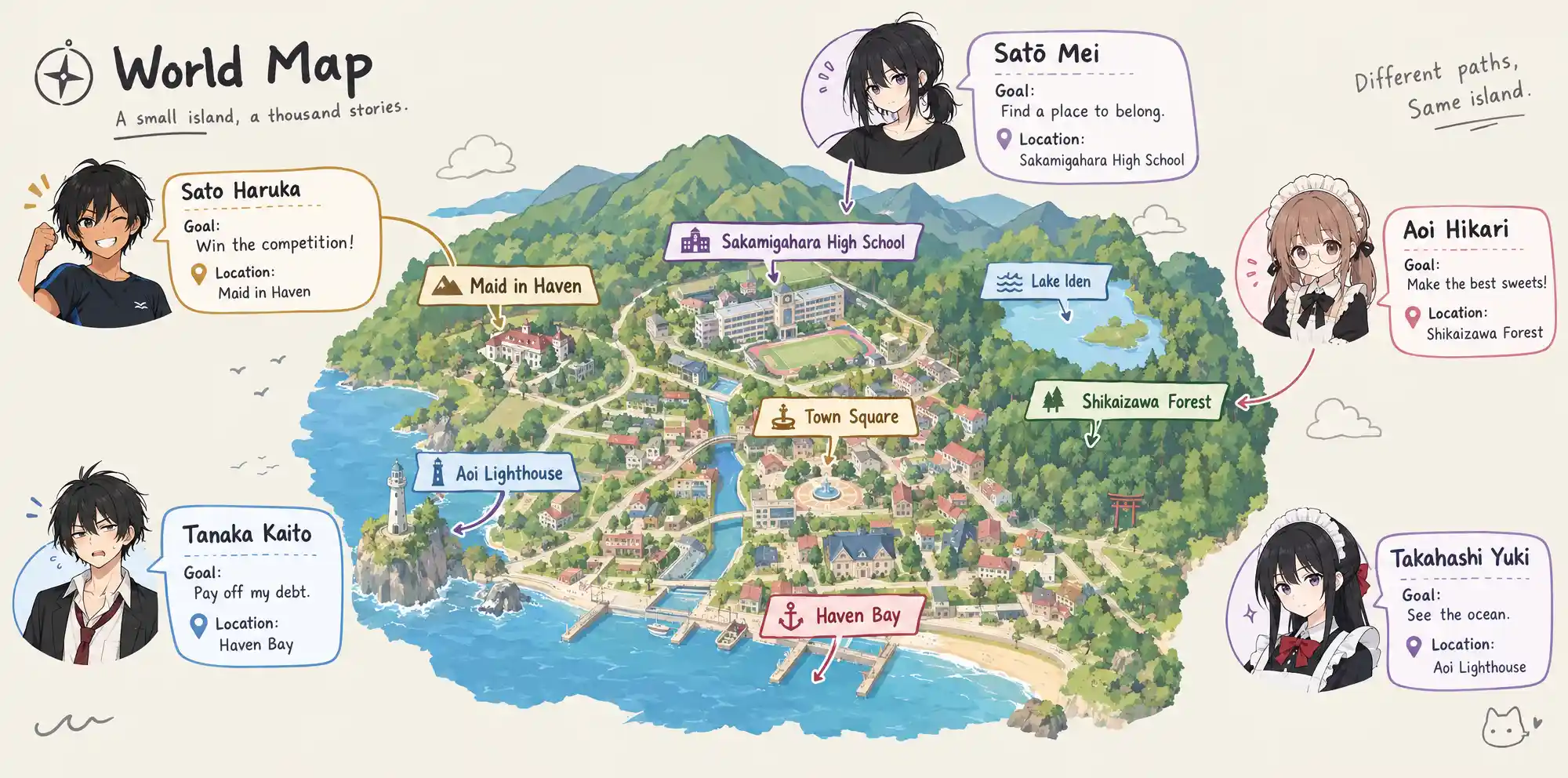
- Geography on a world map.
- Current time and mutable state.
- Selective memory.
- A Phase Graph that keeps the larger story inside creator-set bounds.
The result is a world that can react, remember selected facts, and continue a journey without becoming an unrestricted improv session.
The world model
Before play, creators define:
- Who lives in the world.
- How they are connected.
- Where they are.
- What rules constrain them.
- What secrets and pressures already exist.
- How the larger story may progress.
Players enter that model instead of starting from an empty chat.
During play
Each turn can read and, where supported, update:
- Current world time.
- Compact current-state facts.
- Map positions for characters in motion.
- Memory of important events.
- The active World Phase.
The world-simulation step can update map positions when a character's current intent, goal, or plan implies movement. It does not create a separate economy, weather system, or autonomous offscreen storyline.
Why this matters
This lets later scenes use:
- A faction that already existed.
- A location already placed on the map.
- A relationship with direction and history.
- A secret the player has not discovered yet.
- A phase the creator defined as the next valid pressure.
Build the model in the World Editor, then see how play uses it in Play Runtime.