
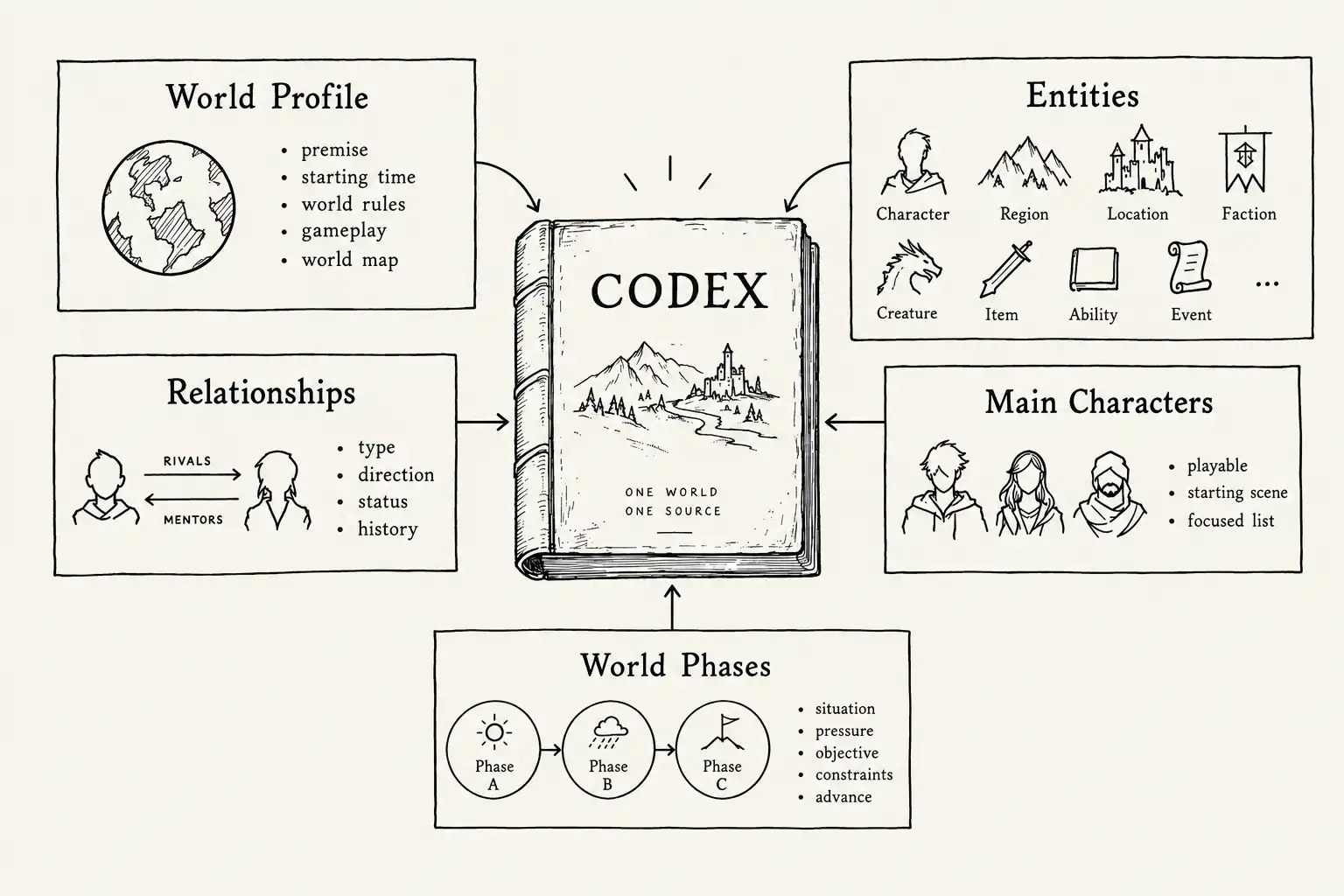
Core Concepts
These are the parts that make the world in your head hold together. Learn the names once. The editor, play runtime, and publishing flow all use them.
Codex
A Codex is the structured knowledge base for one world. Premise, entities, relations, rules, phases, map, media, and presentation all live in the same model.
Treat the Codex as the main record for the world, not a pile of disconnected notes. The editor, image tools, publishing flow, and play system all read from it.
World Profile
The World Profile holds setting-wide information:
- Premise and lore.
- Starting time and world rules.
- Gameplay definitions.
- World map.
Put facts that belong to one character, faction, place, or object on that entity instead.
Entities
An entity is a reusable part of the world: Character, Region, Location, Race, Creature, Item, Object, Faction, Ability, Event, Myth, Fact, or Lore.
Each entity has a stable ID. Relations, map markers, phases, and starting scenes use that ID, so rename IDs carefully.
Relationships
Relations are graph links with type, direction, status, and history. They describe durable meaning such as RIVALS, MENTORS, OWNS, SERVES, or LOCATED_IN.
Direction matters. A-[OWNS]->B is not the same as B-[OWNS]->A.
Main Characters
A Main Character is a viewpoint a reader may enter. Keep the list focused. Every Main Character needs a playable starting scene before publishing.
Players act through the chosen character. They do not become every object, creature, or concept in the world.
World Phases
A World Phase is a story state, not a chapter. It defines situation, pressure, objective, constraints, and when to stay or advance.
Edges define valid progression. An ending phase has no outgoing edge and concludes the current play journey.
Memory
Dai Novel uses selective long-term memory:
- Working memory captures recent events.
- Episodic memory keeps important story moments.
- World memory preserves durable truths.
The next scene can remember what the last one changed. It does not store every line of dialogue forever.
Working world and snapshots
The editor contains your working version. Publishing creates a versioned snapshot. You can keep editing after a snapshot and publish a later version when the changes are ready.
Play journey
During play, the runtime combines Codex data, current World Phase, previous scenes, memory, relationships, map state, and player input to produce the next illustrated page. Meaningful changes can become part of later world state.