
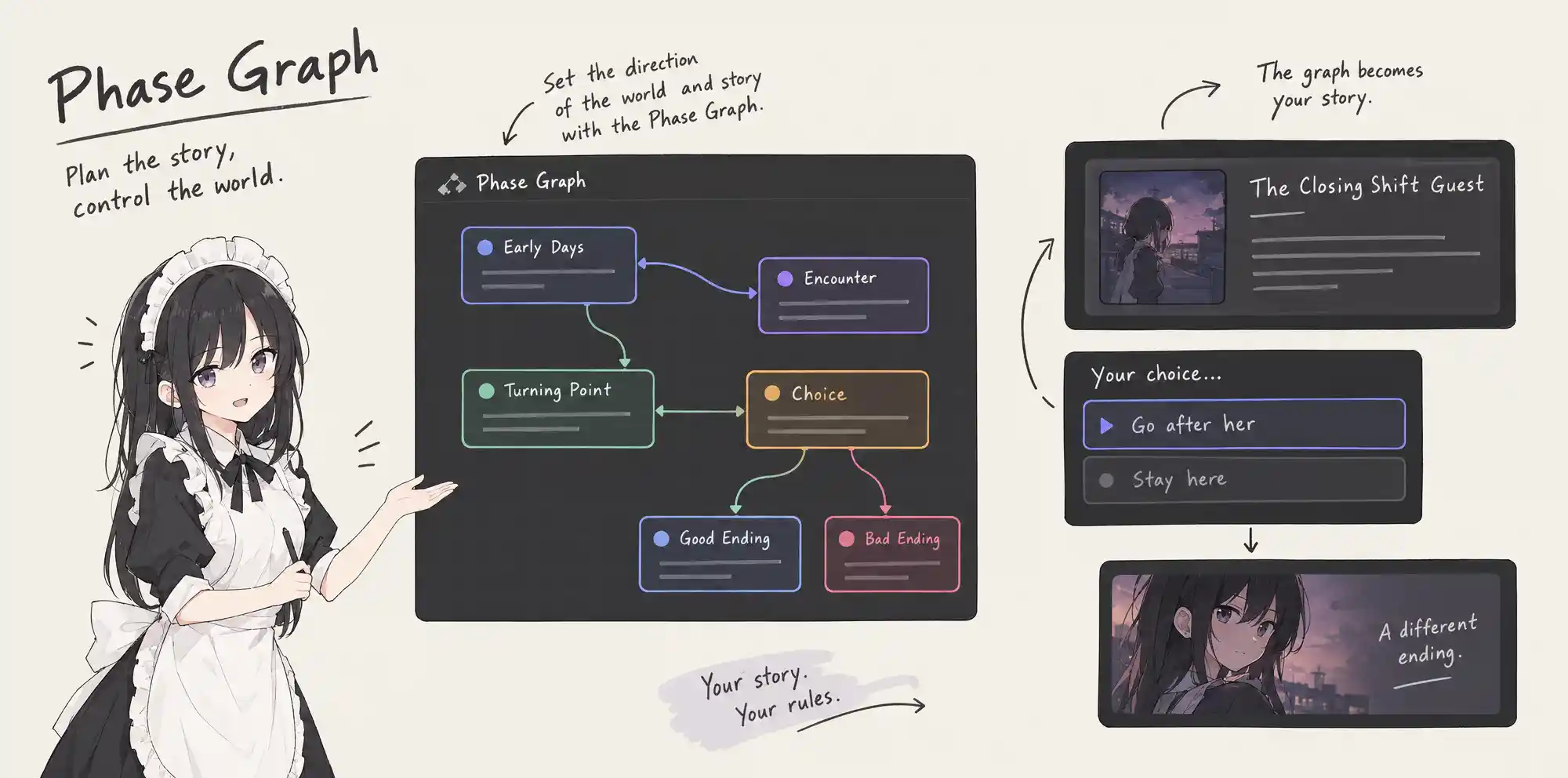
World Phases
Shape the story direction.
World Phases define how the larger story may progress without prewriting every scene. Open Phases in the World Editor sidebar to view the graph.
A phase is a flexible narrative state, not a prewritten chapter or required scene sequence. The AI writes the moment. You keep the direction.
Anatomy of a phase
Phase Name
A short, concrete label that is easy to scan on the graph.
Player Description
A reader-facing summary of the situation and stakes. Keep internal direction out of this field.
Phase Content
Internal context for Director and Writer. Describe the dramatic purpose, current world state, active pressures, objective, and tone. Also say the situation the phase opens on and its time scale (one night, a season, years): in play, the next phase is chosen from this text alone.
A useful shape is:
PURPOSE: the dramatic job of this stage
STATE: conditions that remain true while the phase is active
PRESSURES: factions, scarcity, danger, or obligation squeezing the cast
OBJECTIVE: one verifiable end-state
KR1/KR2/KR3: observable results
TONE: the intended emotional register
BG LINK: how the background story system advances
Progression Logic
Say when the story leaves this phase, and which next phase fits which evidence. Two or three short lines are enough:
ADVANCE: After they commit to a faction or find a route into the vault
BRANCH: phase_vault_s2_0 if they side with the guild; phase_vault_s2_1 if they go in alone
AVOID: Do not reveal what is inside the vault yet
Write conditions someone could check in play ("after the player publicly sides with…"), never "when the story feels ready". Pacing and time scale belong in Phase Content.
Graph rules
- Each scope has one entry phase at step 0.
- Outgoing edges must point to a later step.
- A phase may branch to several valid next phases.
- Several branches may converge on one later phase.
- Every non-ending leaf should connect forward when the story needs another stage.
- An ending phase must have no outgoing edge.
During play, the saved phase stays on the current phase or moves to one connected next phase. The scene itself can still vary within that direction.
Build a first arc
Begin with three connected phases: ordinary pressure, a real trial, and a point of no return. Expand only after each stage has a clear objective and transition rule.
Character branches
Build a shared world spine, then add a separate branch for a Main Character when their story needs to diverge.
Hooks and payoffs
Plant important promises before their payoff phase. Keep the number of open hooks manageable and give core hooks visible progress before the final reveal. Hook lines in Progression Logic are read by Story Studio; the writer never sees them in play, so a promise you want kept alive also belongs in Phase Content.
World changes
A phase can also change the world when the story enters it: bring in a character held back until then, give someone a new look, switch the map, or rewrite the premise or game rules. The start phase never changes anything. See Phase Changes and the Phase Lens.
Use Phase Architect when you need help planning a larger graph.