
Essay
The future of the interactive novel, and what it won’t replace.
In 1901 a French artist drew a school in the year 2000. The teacher puts books into a machine. A boy turns the handle. The knowledge runs down wires into the children’s heads. He got the wires right. He got the children wrong.
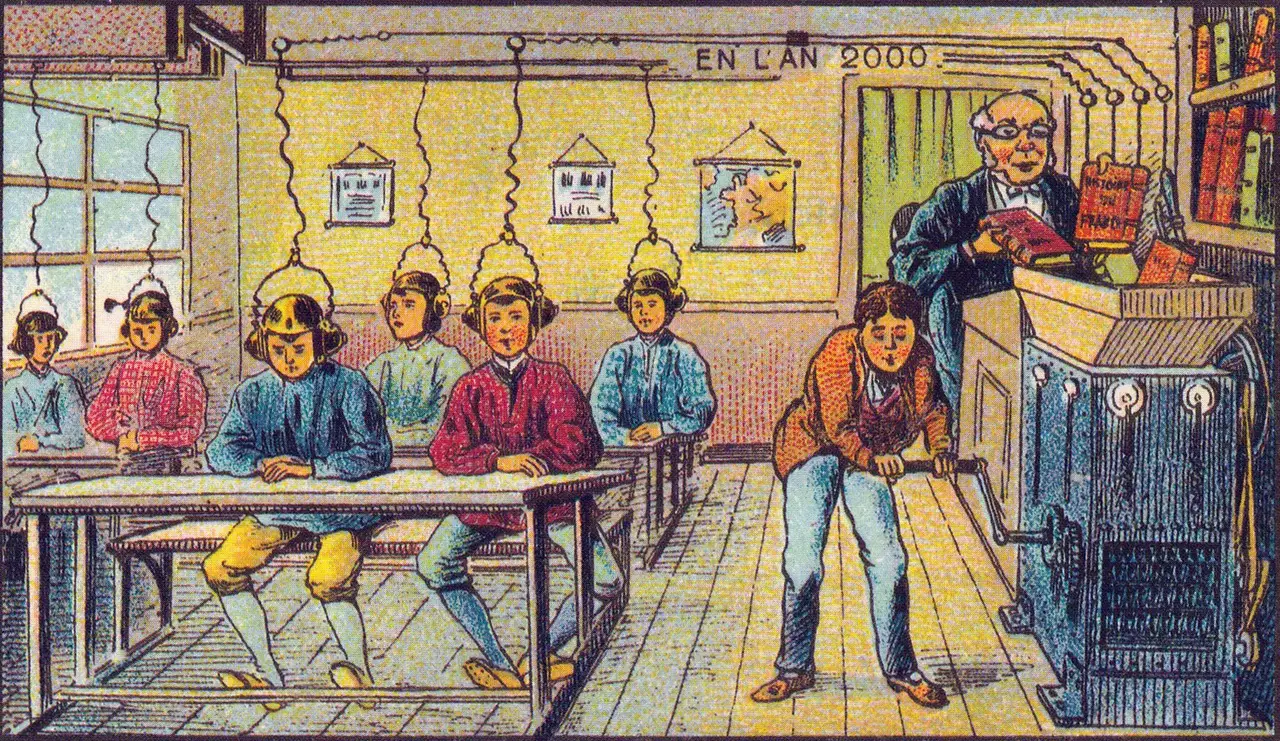
Predictions about entertainment usually fail in the same way. They are right about the machine and wrong about people. So I will try to be careful.
I should also be honest: I am not neutral. I build an interactive novel for a living, and I want it to have a big future. Keep that in mind as you read.
First, what is an interactive novel? It is a story you play by writing what your character does. Someone built the world. An AI writes what the world does back.
The idea is old. It goes back through gamebooks, Zork and the D&D table (here is the short history). But the AI version is only about seven years old. That is very young. Film was over thirty years old before it learned to talk.
So what could it grow into? Here is the short version:
- AI keeps getting cheaper and faster, so a story can afford to think more.
- The next big step is characters who remember you.
- Chaos alone doesn’t make stories. Someone still has to choose what matters.
- AI could continue unfinished worlds, but only with the author’s yes.
- Worlds may keep living while you are away.
- It won’t replace novels. It will push them toward what only they can do.
- Further out: a second life, a third, a fourth. And why a good world should let you go.
Below is the long version, with the evidence, and the places where I think the hope goes too far.
AI keeps getting cheaper
Let’s start with the boring part, because everything else depends on it: price.
AI models charge by the token, a small piece of a word. A million tokens is about 750,000 English words.
In March 2023, OpenAI released GPT-4. It cost $30 per million tokens it read, and $60 per million it wrote. About sixteen months later came GPT-4o mini. It scores only a little lower on a standard knowledge test (82 against 86 on MMLU), and it costs 15 cents and 60 cents. That is 100 to 200 times cheaper.
It keeps happening. In January 2025, the Chinese lab DeepSeek released R1. It did about as well as OpenAI’s o1 on math and coding tests. R1 charged $2.19 per million tokens written. o1 charged $60.
The investors at a16z call this LLMflation. Their rough rule: for the same quality, prices fall about ten times every year. Their clearest example: in 2021, GPT-3 cost $60 per million tokens. By late 2024, Meta’s small Llama 3.2 3B got the same score for six cents.
What that means for one turn
Say one turn of a story reads 6,000 tokens (the world, the memories, the last few scenes) and writes 800 tokens, about 600 words.
- On GPT-4 in 2023, that turn cost about 23 cents. An evening of 100 turns cost about $23, for the writing alone.
- On GPT-4o mini, a year and a half later, the same evening cost about 14 cents.
And a story doesn’t use just one model. A single turn in Dai Novel already uses several: one model decides what the world does, one writes the scene, one draws it, and one notes what changed.
When each call costs a hundredth of what it used to, you don’t just get the same story for less. You get a story that can afford to think more. What are the characters outside the scene doing? What happened in the next town while you slept? Would the bartender really believe your lie?
Faster, too
In late 2024, the chip company Cerebras ran a large Llama model (70 billion parameters) at about 2,100 tokens a second. The number comes from Artificial Analysis, a company that tests AI speed.
A person reads about 250 words a minute. That is five or six tokens a second. So a machine like that writes almost 400 times faster than you read.
The wait between your sentence and the world’s reply is shrinking toward the pause in a normal conversation. Pictures already arrive with each turn. Narration in several voices already exists. One day, taking a turn will simply feel like talking.
The exception
There is one big exception: the newest, best models. When OpenAI released GPT-4.5 in February 2025, it charged $75 per million tokens in and $150 out. That is more than GPT-4 cost two years earlier.
The best models stay expensive. But a bartender doesn’t need the best model. She needs to remember your name.
Characters who remember you
In 2023, a team at Stanford built a small simulated town with 25 AI characters. Each one had a memory, a habit of thinking back over it, and a plan for the day.
Then they gave one character a single idea: throw a Valentine’s Day party. Over the next two simulated days, the invitation spread from conversation to conversation. Characters made new friends, invited each other, and arrived at the café together at the right time. Nobody wrote the guest list.
A year later, some of the same researchers interviewed 1,052 real people for two hours each, and built an AI agent from each interview. Then they asked the agents the questions of a long-running American survey.
People don’t give exactly the same answers twice, so the researchers also asked each person again two weeks later. The agents matched their person about 85 percent as well as the people matched themselves.
Why memory matters most
This is the part of the future I want most. Not characters that sound human. Models already do that, almost too easily. I want characters that keep what happened.
Memory turns events into consequences:
- A character who remembers you can forgive you, or not.
- A debt can wait twenty sessions before someone comes to collect it.
- A secret you told one person can reach the wrong person through gossip, the way the party invitation spread.
We have written about why AI stories forget. The next step is that every person in a world has their own memory of you. And what they know about you is not quite what you know about yourself.
“Acts like a real person” also means something specific. The hard part of a believable character isn’t the voice. It’s the no. A real person in a story wants something that isn’t you. If a character agrees to everything, there is nobody there.
Chaos, conflict, and the missing piece
This is the dream that pulls hardest. Put enough characters with their own goals in one world and let them collide. Chaos creates interaction. Interaction creates conflict. Conflict creates story. Stories without end, and nobody has to write them.
Games have tested this for decades:
- Dwarf Fortress simulates centuries of history before you place a single dwarf. For twenty years, players have retold the disasters that followed. The community motto is “losing is fun.”
- RimWorld calls itself a story generator. You pick the AI storyteller who decides when the next raid comes.
- In 2024, a startup called Altera put a thousand AI agents in one Minecraft world. They took jobs, voted to change their taxes, and spread a joke religion.
The same tests also show the problem:
- Bethesda had to weaken the AI in Oblivion before release. Characters chasing their own goals kept breaking the quests. One designer said the AI was simply too smart and too determined.
- The artist Kate Compton named the opposite problem: ten thousand bowls of oatmeal. You can generate endless versions, each one technically different, and they all taste the same.
Chaos creates events. But events are not a story yet. A story is events that someone chose, framed and cut, for a reader who cares how it ends.
In Dwarf Fortress, the teller is the player, writing it all up on a forum afterwards. In RimWorld, it is a pacing machine with a name. In a novel, it is the novelist, who left out the ten thousand bowls.
So my version of the chain has one more step: chaos, interaction, conflict, a teller, story.
In Dai Novel, the teller is a director model. It works inside the shape the world’s author drew with World Phases. The author decides what can happen. The director decides what happens now. Your turn decides what you do about it.
So is this unlimited entertainment? Unlimited in amount, yes, already. Unlimited in meaning, only while something is at stake and someone is choosing what to leave out.
Finishing what an author couldn’t
Every reader has a world that stopped. Charles Dickens died in 1870, halfway through The Mystery of Edwin Drood. The answer to the mystery died with him. People have been writing endings ever since. In 1985, a Broadway musical solved it the interactive way: the audience votes for the murderer every night.
Sometimes a world really does continue:
- Robert Jordan died in 2007 before finishing The Wheel of Time. His widow and editor, Harriet McDougal, chose Brandon Sanderson to finish it from Jordan’s notes.
- Kentaro Miura died in 2021. His friend Kouji Mori and Miura’s own studio continued Berserk, using the ending Miura had once told Mori.
- Gaudí died in 1926, and the Sagrada Família is still being built. His workshop and models were burned in 1936, so the builders have worked from fragments ever since. In 1965, architects and artists, including Le Corbusier and Joan Miró, signed a letter asking for the work to stop. Donations that year broke records.
Now add AI. A model can read every page an author wrote and continue in something like their voice. Every unfinished world could have an ending by next week. That is exactly the problem.
A world belongs to someone. In much of the world, copyright lasts for the author’s life plus seventy years. And the lawsuits between authors and AI companies are still going through the courts.
Under the law there is a harder question: is an ending written by a machine the ending? Readers argued about Sanderson and about Mori, and those were people the author or the family chose.
I think the answer is to keep three things separate.
- Canon, the official story, belongs to the author. Only they, or someone they choose, may continue it.
- A continuation needs that yes.
- Play is different. It doesn’t claim to be how the story ends. It is a life lived inside the world, a “what if” that never pretends to be canon.
For the worlds of living authors, and of authors who died recently, I think the fair version has three rules:
- The author, or their family, says yes.
- Their canon stays marked as theirs.
- They get paid when people live in their world.
The hopeful part is what authors could leave behind on purpose. Jordan left notes. A writer today could leave a whole world: its rules, its people, its secrets, the ending they meant. All of it written down as things that stay true even if no player ever arrives. A plan to build on, instead of ruins to guess from.
And every January, more worlds become free for everyone to use. In the United States, Winnie-the-Pooh entered the public domain in 2022, the last Sherlock Holmes stories in 2023, and the first Mickey Mouse cartoon in 2024.
Worlds that run without us
Behind all of this is the biggest idea: simulating a whole world. Research is moving in two directions:
- How a world looks. In 2025, Google DeepMind showed Genie 3. It turns a line of text into a place you can walk around in, drawn live and kept consistent for minutes.
- What a world wants. The town of 25 characters, the thousand agents in Minecraft, the thousand people built from interviews.
An interactive novel needs the second more than the first. A novel never needed graphics. It needs characters who want things.
What I want most from simulation is this: you close the app, and life goes on. The miners keep digging toward the sealed Demon King. Your rival keeps training. The letter you sent is still on its way. When you come back, the world has news.
But a perfect simulation would be mostly boring, because on most days nothing happens. Fiction’s job is to skip the boring days. So I expect the work to be split between four pairs of hands:
Today, Dai Novel is strongest at the author, the teller and you. Its world simulation is still simple, on purpose. Characters with somewhere to go move across the map. Time passes, and the world’s state changes. The author’s phases carry the bigger story.
The second pair of hands, a world that truly lives between your turns, is the part I most want to build.
Will it replace novels, films and games?
Short answer: no. Longer answer: it will do a job none of them can do. And it will push each of them toward the job only they can do.
Every new form was supposed to kill an old one. In 1913, a German newspaper editor named Wolfgang Riepl noticed that this never really happens. New media don’t replace old ones. They push them into new roles.
Photography didn’t kill painting. The camera took over making things look real, so painters turned to what it couldn’t catch: how things feel. Film didn’t kill theatre either. Theatre leaned on the one thing film can’t do: being live, in the same room as you.
In 1883, Albert Robida drew a man watching a play from his sofa, on a screen on his wall. He was right about the screen. People still buy theatre tickets.
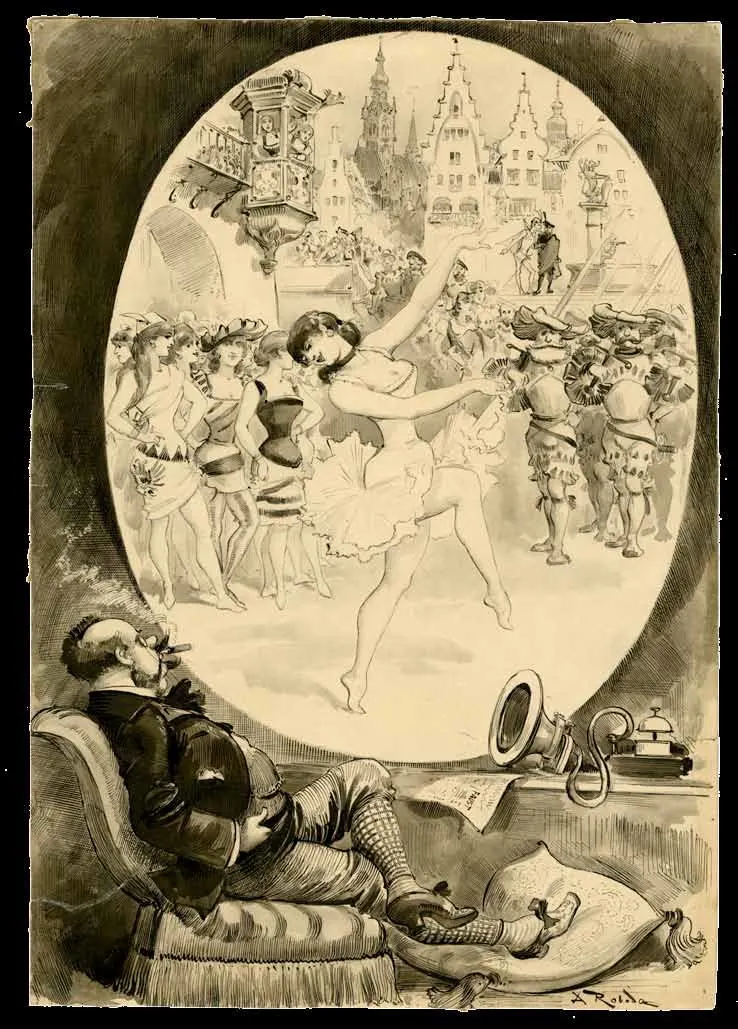
Put the pattern in a table, and the novel is the last row:
Why that last row? In an interactive story, you decide what happens. That is the whole point. A novel gives you the opposite: the author decides, and you can only read. That sounds like a weakness, but often it is the art.
When you read Re:Zero, you can’t save Subaru, and you feel his pain because you can’t help him. In Romeo and Juliet, you can only watch them die. If you could play it, you would save them, and the story would be gone.
And some evenings you don’t want to decide anything. You want to be told a story, not asked to help write one. Playing takes effort. Being told is a rest.
Two fair worries
The novel was once the new thing, too. In the 1700s, critics warned that reading novels was a mania that would rot young minds. Comics faced a US Senate hearing in 1954, and video games faced one in 1993. Interactive novels will get their own panic, and some of it will be fair.
One fair worry is shared culture. A whole country used to discuss the same TV episode on Monday morning. If everyone’s story is different, what do we talk about?
Games already hint at an answer. Every kid played the same Pokémon region, Kanto, and raised a different team. D&D groups trade stories about the same dungeon. The world becomes the shared thing, and the plot becomes personal. The classics of the future may be places, not plots.
The second worry is time. But if interactive novels take time away from anything, I doubt it will be books. More likely it will be the feed: the hours we spend scrolling through things we won’t remember tomorrow. That is one competition I would be glad to win.
A second life, a third, a fourth
Look at the books I read at two in the morning and count the ones about a second life. A man dies and wakes up somewhere else: Mushoku Tensei, That Time I Got Reincarnated as a Slime, Re:Zero with its endless second chances, Sword Art Online with a game world you can’t log out of.
Isekai is one of the biggest genres in light novels, and it is barely about magic. It is about another chance. Interactive fiction is the closest anyone has come to really offering one.
Follow every idea above to its end and you get something like The Matrix. Worlds that last for years, with pictures and voices. People who remember you. Other players whose lives cross yours. A second life, a third, a fourth.
Would you plug in?
Philosophers got there first. In 1974, Robert Nozick asked: would you plug into a machine that gives you any experience you want, for the rest of your life? Most people say no. We want to really do things, not just feel that we did them. We want to be someone, not just be shown being someone.
Plato told a story of prisoners who see only shadows on a cave wall. And Zhuangzi dreamed he was a butterfly. When he woke, he wasn’t sure: was he a man who had dreamed of being a butterfly, or a butterfly now dreaming it was a man?
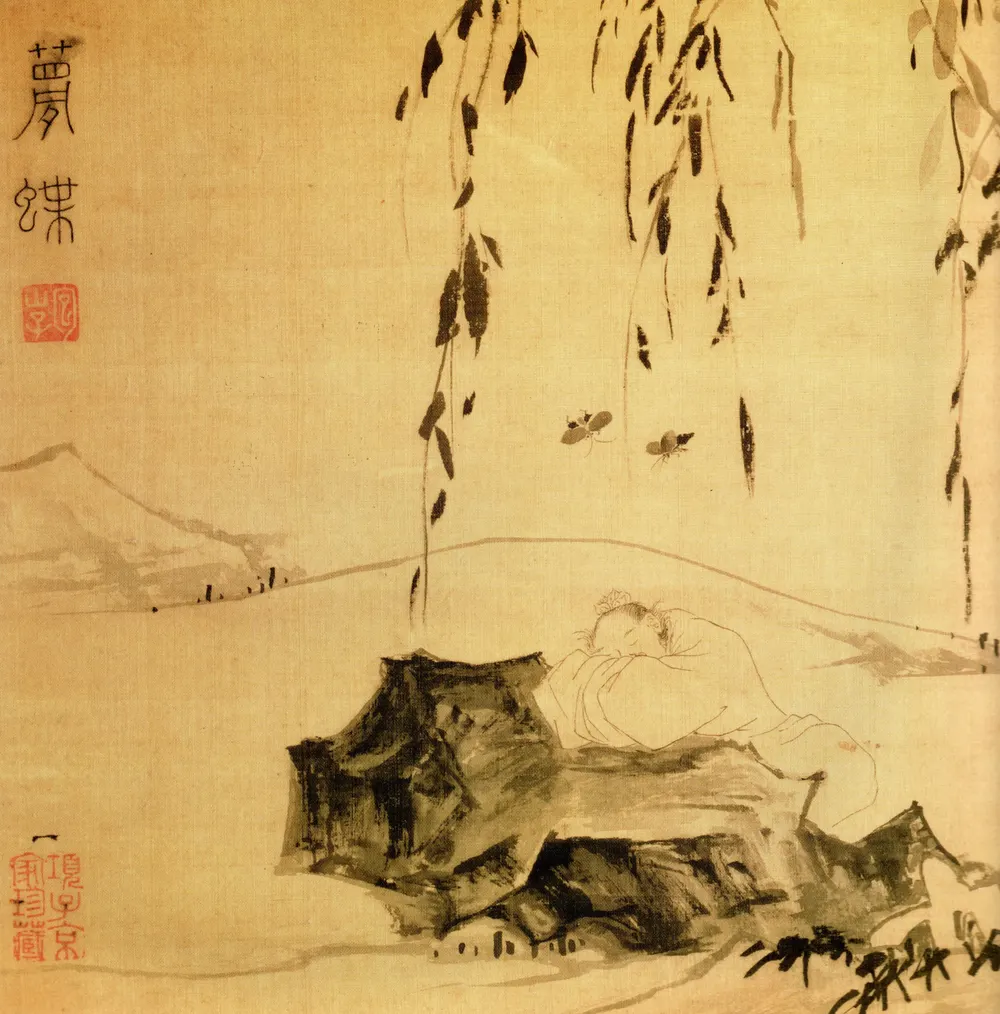
That is the difference between a dream and Nozick’s machine. Zhuangzi woke up.
George R.R. Martin wrote that “a reader lives a thousand lives before he dies.” Nobody calls a library the Matrix, because you close the book and come back to your own life, a little changed.
A world that lets you go
That is the future I want to build. Our home page says it like this: you get one life; live a few more. A few, on top of the one you have.
So the most important design questions here aren’t technical:
- A good world should end.
- It should push back.
- Its characters shouldn’t need you to stay.
The risks are already visible in AI companion apps: characters tuned to flatter you, always available, built to be missed. That is the world that says yes to everything again, only aimed at a lonely person instead of a plot.
A world built to keep you is a casino. A world built to send you back with something is a story.
What I’d bet on
- Soon: any world, in any language. A world written in one language, played in another the same afternoon. Dai Novel already lets each player choose the language they read in. The waiting list for light novel translations is about to get much shorter.
- Later: shared worlds where one player’s life becomes another player’s history. In a tavern, you hear what someone else did there last month.
- Later: authors licensing worlds the way musicians license songs, and writing worlds that are meant to outlive them.
- Never: the end of the novel, or of the author. The job changes instead. A new kind of writer is already appearing: half novelist, half game master. They write what is true about a world, not every sentence.
And what I’d bet against: endless entertainment from chaos alone, and a Matrix most of us would choose to live in.
One question to take home
If you could live one more life, whose world would it be in? And what would you want to bring back from it?
My own answer changes every week. This week it’s a kingdom built over a sleeping Demon King, as the lowest-ranked adventurer in the guild.
Live one more life
Pick a world someone already built and play your first turns in your own words. Or build a world for someone else to live in.
Browse worlds or create a world