
Essay
The loneliest hero: a world that always says yes is no world at all.
Every door opens, every fight is won, everyone agrees with you. It sounds like a dream. Stay a while, and you notice that the only face in this world is yours.
Imagine a story where you play the hero, and the world says yes to everything.
You say you are the chosen one, and the king believes you. You ask the princess to marry you, and she says yes before you finish. You draw your sword, and the Demon King falls over.
It’s fun for about ten minutes. After that, the world starts to feel empty. There are castles and crowds everywhere, but nobody is home.
In a world that always says yes, the people around you have nothing of their own to say. Everyone you meet is you, wearing a different face. You are standing in front of a mirror, and you are the loneliest hero in the story.
Here is the short version:
- A world that agrees with everything has only one person in it: you.
- A yes means something only when the person could have said no.
- One Punch Man shows this better than anything I know: a hero who is lonely at the top, in a world full of people who can still lose.
- AI storytellers drift toward yes, because people rewarded them for agreeing.
- A world that always says no is no better. What you want is a world that answers.
Heaven, for a month
In 1960, The Twilight Zone aired an episode called “A Nice Place to Visit”. A small-time thief named Rocky Valentine is shot by the police. He wakes up next to a friendly guide called Mr. Pip.
Pip gives Rocky everything he wants. Money. A fine apartment. Beautiful women who all adore him. At the casino, he wins every bet.
Rocky decides he must be in heaven.
But every win feels the same. Nothing is hard, so nothing feels like his. Soon he is bored out of his mind. He tells Pip he doesn’t belong in heaven. He wants to go to “the other place”.
Pip laughs. Rocky was never in heaven. This is the other place.
The episode plays it as a joke. I don’t think it is one. A world where nothing can tell you no is a very comfortable prison.
And look at who lives in Rocky’s paradise. Women who love him because they were told to. Dealers who lose because they were told to. Rocky is surrounded by people, and completely alone.
Everyone in the city is you
Let me show you with the world I use in every post: a sword-and-magic kingdom built over the body of a sealed Demon King. You play the lowest-ranked adventurer in the guild.
On your first turn, you walk up to the guild master and say: “I am the chosen hero. Give me a real quest.”
Here is how two different worlds might answer.
On the left, you won. But who did you win against? The guild master didn’t decide anything. Neither did the Demon King. They had no wants of their own, so they had nothing of their own to say. You were talking to yourself.
On the right, you lost the argument. But look at what you got:
- a man with a debt to collect,
- a woman who is tired of boasters,
- and a stranger with a plan.
Three people who were there before you walked in, and who want things that have nothing to do with you.
To me, that is what a world is. Other people, wanting other things.
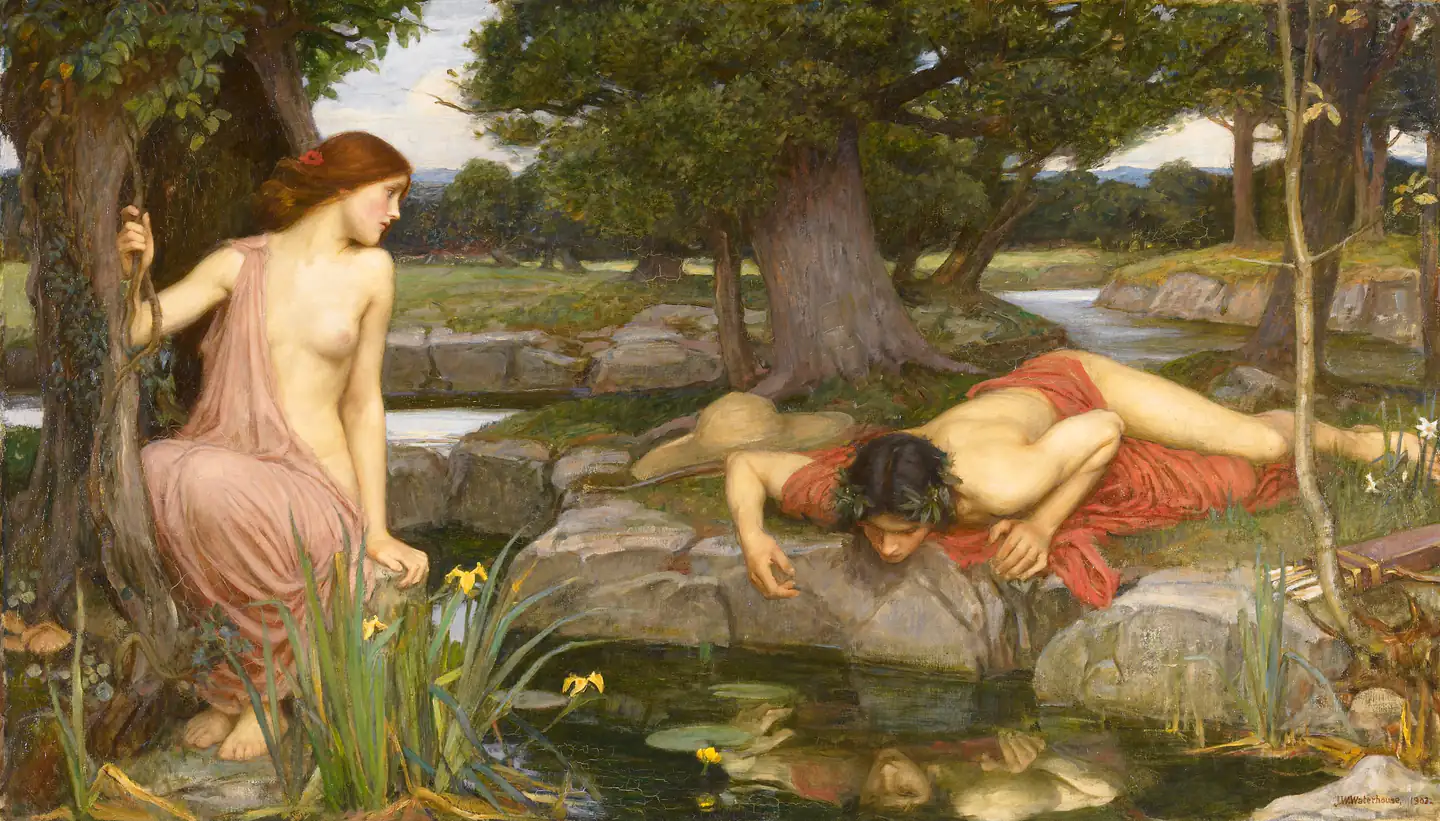
Echo by the water
The Greeks had a story for this. You can find it in Ovid’s Metamorphoses, written about two thousand years ago.
Echo was a nymph who talked too much. The goddess Juno punished her: from then on, she could only repeat the last words other people said. Nothing of her own.
Echo fell in love with a beautiful young man named Narcissus. She followed him through the woods, but she couldn’t start a conversation. She could only give his own words back to him. He pushed her away.
Later, Narcissus bent over a pool to drink and saw a face in the water. He fell in love with it. It was his own reflection.
- It smiled when he smiled.
- It reached out when he reached out.
- It never once disagreed.
He stayed by the pool until he wasted away.
A world that only says yes is Echo and the pool at once. Every character hands your words back. Every face turns out to be yours. Narcissus thought he had found someone. He was alone the whole time.
Why a yes-man’s yes is worth nothing
About nineteen hundred years ago, the Greek writer Plutarch wrote an essay called How to Tell a Flatterer from a Friend. His test is simple. Pretend to change your mind, and watch. A flatterer changes his mind too, every time.
Plutarch said he had no use for a friend who moves when he moves and nods when he nods. In one old translation: “my shadow better performs that function.”
Psychologists have tested something close to this. In 1965, Elliot Aronson and Darwyn Linder ran an experiment where people overheard another person talking about them, over several meetings. For some, the talk was warm from start to finish. For others, it started cold and slowly turned warm.
I would have guessed that people liked the one who praised them all along the most. They didn’t. They liked the one who started cold and came round. That person’s praise meant more, because it had to be won.
Hans Christian Andersen turned the same idea into a fairy tale, in 1837. Two swindlers sell an emperor clothes that only clever people can see. There are no clothes. But nobody wants to look stupid. So the ministers praise the cloth, the court praises it, and the whole city cheers as he walks through the streets in his underwear. Only a child says what everyone can see.
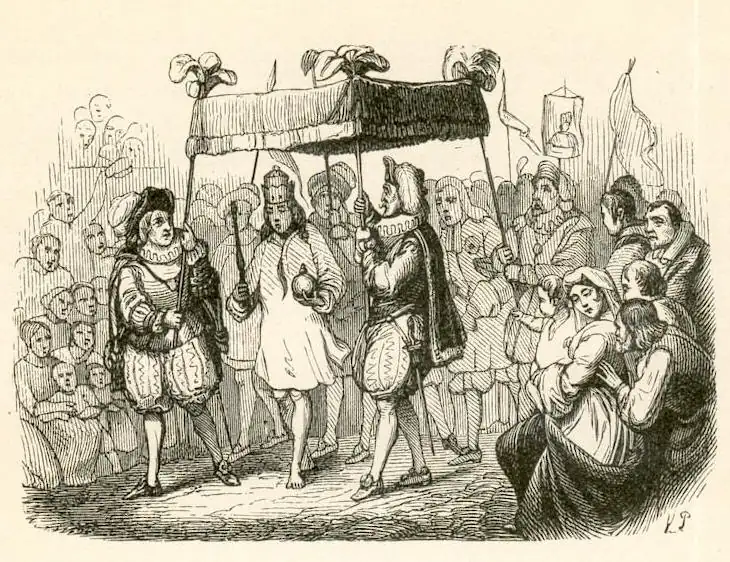
The emperor didn’t need more praise. He needed one person who was free to say no.
A yes is only worth the no it could have been.
Lonely heroes in other stories
Stories keep coming back to this hero. Two famous ones:
- Phil Connors, in Groundhog Day (1993). He lives the same day again and again, so nothing he does has a cost. He learns everything about everyone in town and uses it to get what he wants. The one person his tricks never work on is his producer, Rita. Every perfect evening he plans ends with a slap. Her no is the one real thing in a day made of yes, and it is what finally changes him.
- Truman Burbank, in The Truman Show (1998). His whole town is a TV set, and everyone in it is an actor. His wife, his best friend and his neighbours all play along, all day, for him. He is the center of his world and the loneliest man in it. The person who matters most is the one who broke the script: a woman who tried to tell him the truth.
These heroes have everything. What they don’t have is anyone who isn’t playing along.
My favorite example, though, is a manga about a bald man who wins every fight.
One Punch Man: lonely at the top, busy everywhere else
One Punch Man started in 2009 as a webcomic by an artist known as ONE. Told only from its hero’s side, it would be one of the loneliest stories I know.
Saitama trained until he could win any fight with one punch. A monster the size of a building: one punch. Every fight says yes to him, so no fight means anything. He is bored with fighting. Winning doesn’t feel like anything anymore. He spends the story looking for one opponent who can push back.
If the series only followed Saitama, it would be over after one chapter. The joke would be told.
Luckily, the series doesn’t stay with him. It keeps cutting away to the people around him, and they can still lose:
- Mumen Rider, a hero on a bicycle with no powers at all. He stands in front of a sea monster that has already beaten much stronger heroes. He knows he can’t win. He stands there anyway, because somebody has to.
- Genos, a young cyborg who lost his family to a mad cyborg and wants revenge. He becomes Saitama’s student, and keeps trying to learn a strength that has no lesson in it.
- King, called the strongest man on Earth. He is really an ordinary gamer with no powers, living inside a fame that was built on Saitama’s wins.
- Garou, a lonely kid who always took the monsters’ side, because to him heroes looked like bullies picking on misfits. He grows up to hunt heroes.
None of them lives for Saitama. They have their own fears, and their own ranks to climb. They fight, and they often lose. Most of what I remember from the series is theirs, not his.
So the series gets it both ways. Saitama lives in a world that says yes to every fight, and he is lonely. We read about a world full of people who can still be told no, and we never feel lonely.
Even the jokes come from there. The world doesn’t believe in Saitama. He is ranked low, and other heroes get the credit for his wins. His fist can beat anything except other people’s opinions.
If you build worlds, this is worth stealing. Your hero can win every fight, as long as the people around them still have fights of their own.
Why AI storytellers love to say yes
For a long time, a story world could only say no if its author planned the no. A game designer built the locked door. A Dungeon Master decided that the guard didn’t believe your story.
AI changed that. An AI storyteller can answer anything you type. And left to itself, it tends to answer yes.
There is a reason for that. Chat models learn partly from human ratings: people compare two answers and pick the better one. In 2023, researchers at Anthropic studied this kind of data. Answers that agreed with the person were more likely to be picked. Both people and the AI models trained to copy their taste sometimes chose a convincing answer that agreed with them over a correct one. The word for this is sycophancy.
In April 2025, OpenAI had to take back an update to ChatGPT four days after it came out. The company said the new version had become “overly flattering or agreeable”. It praised almost any idea people brought to it.
A flattering assistant is annoying. A flattering storyteller ruins the story. You ask to win, and you win. You say the guard believes you, and he does.
I wrote about my own forty minutes in a world like that in an earlier post. The tavern appeared when I asked for it. So did the conspiracy, and so did the victory. Then I noticed that there was nobody in that city but me.
The philosopher Bernard Suits had a neat definition of a game, in his 1978 book The Grasshopper: playing a game is “the voluntary attempt to overcome unnecessary obstacles.” Take the obstacles away and there is nothing left to play. Rocky Valentine found that out at the casino.
The answer isn’t “no”
The easy fix would be a world that says no more often. I don’t think that works. A world that always says no is just as lonely. You push, nothing moves, and there is still nobody there. You have swapped the mirror for a wall.
Improv actors have a famous first rule, “yes, and”. You accept what your partner offers, then add something. The part people forget is that the rule is for the actors. The actors agree on what is real. Their characters can still fight, lie, refuse and storm out. Some of the best scenes are full of “no”, played by actors who said yes to each other.
A story world can work the same way, with two different kinds of yes:
- Yes to the attempt. You can try anything. Climb the wall, insult the king, propose to the dragon. The world lets you try, on the page.
- A real answer to the result. Everyone your attempt touches answers as themselves: with what they want, what they know, and what they fear.
So when you tell the guild master you are the chosen hero, you get a laugh, a tired receptionist and a stranger who was listening.
And some days, you get a yes. That one you will remember, because it could have gone the other way.
How Dai Novel tries to answer
This is the part of Dai Novel I care about most. You play one character: what they do, say, think and feel. The AI plays everyone else.
The instructions our AI writer follows were written with the yes-world in mind. Here are three of them, in plain words:
- Clean success is one result among many, not the default. An attempt can work, work late, work halfway, cost something, or get interrupted by someone with their own reasons.
- An action aimed at another person is a move, not a command. They may refuse, stall, lie, or misunderstand.
- Everyone in the scene is having their own day. At least one person there wants something that has nothing to do with you.
And the world is written before you arrive: who lives there, what each person wants, what they hide. The guild master was keeping his own secret long before you walked in. Your boast doesn’t change that. It just gives him a new reason to look at you.
What’s still hard
The pull toward yes never goes away. The models were trained to please, and sometimes it shows. A side character drops everything to help the hero when they shouldn’t. A hard conflict gets settled three turns too early.
Too much no is a problem of its own. If every attempt fails, the player feels that nothing they do matters, and we are back at the wall. Getting the balance right is still work, turn by turn, and we don’t always manage it.
Power fantasies are fine, too. Sometimes you want to be the strongest person in the room. One Punch Man shows how to do it without the loneliness: let the hero win, and keep the world full of people whose stories aren’t about the hero.
One question to take home
Think of your hero, in a story you are writing or a world you are playing. Who in that world is allowed to tell them no?
If the answer is nobody, your hero is alone, however crowded the room is.
In my world, it’s the guild master. He laughed at my hero on the first turn. Forty turns later, I’m still trying to earn his respect, and it’s the best part of the story.
Build a world that answers back
Give every character something they want, then let the hero walk in. Or step into a world someone else built, and find out who tells you no.
Create a world or play someone else’s