
Essay
Why we obsess over characters who feel real: any world works, if its people live there.
We forgive a story almost anything. Dragons, time loops, a hole in the ground that curses anyone who climbs out of it. What we don’t forgive is a person who acts wrong. Why are we so easy on worlds, and so hard on people?
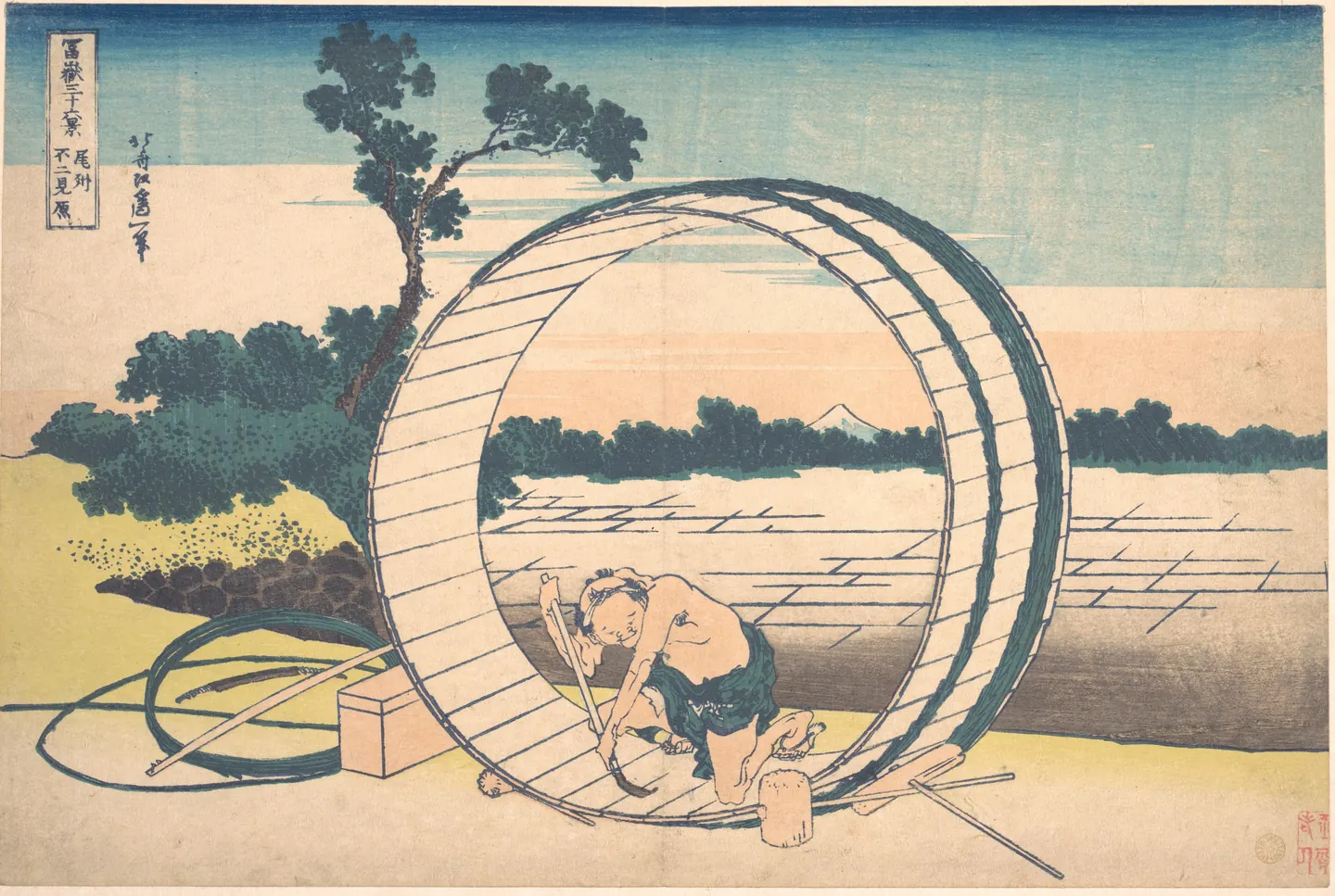
Look at the print. The most famous mountain in Japan fits inside a barrel, and the man making the barrel never looks up.
Every story works like this. You never see a world directly. You see it through somebody, in the middle of their day. So when a world grabs you, it’s because somebody in it feels alive. And when a world leaves you cold, it usually isn’t the world’s fault.
The short version:
- We judge a world by the people in it, because people are what our brains are built to read.
- A strange world doesn’t break the spell. A person who acts wrong does.
- Made in Abyss shows the fix: a town where the world’s one rule lives in everyone’s habits, right down to where the children sit.
- AI characters arrive as tourists. They need to be written as natives.
You never meet a world
In 1944, the psychologists Fritz Heider and Marianne Simmel showed 34 students a short film: two triangles and a circle moving around a box with a door. Only one student described shapes. Everyone else saw people, and more than half told a whole story, with a bully, two friends, a chase and an escape.
We can’t even watch triangles without turning them into people. The part of you that enjoys a story is the part that reads people. A world on its own is a stage set. It comes alive when somebody walks on and moves like they have walked there all their life.
The deal Coleridge made
People quote “willing suspension of disbelief” to mean that readers will swallow anything. Read the sentence it comes from.
In 1798, Samuel Taylor Coleridge and William Wordsworth published a book of poems together. Coleridge took the supernatural: curses, spirits, a ship sailed by dead men. Years later he explained the deal. The ghosts were allowed, as long as the feelings were true, aiming at
the dramatic truth of such emotions, as would naturally accompany such situations, supposing them real.
Only that “human interest and a semblance of truth”, he wrote, earns the reader’s “willing suspension of disbelief”. The ghosts are free. The people are what you pay with.
Researchers have since found the same thing. In 2008, Rick Busselle and Helena Bilandzic reviewed the evidence. Knowing a story is made up doesn’t stop us getting lost in it. Neither does a world with different rules, as long as it keeps them. What pulls us out is a person who doesn’t add up. In one reading experiment they cite, readers learned that a character was a vegetarian. A little later she ordered a cheeseburger, and people slowed down on that line without being asked to check.
Tolkien put it in one line: “The moment disbelief arises, the spell is broken.” It almost never arises at the dragon.
Experts at people, beginners at dragons
Why are we so hard on people and so easy on dragons? Because we have studied people all our lives, and dragons never.
In the 1850s, a French doctor named Guillaume Duchenne made an old man smile with electricity. It never looked right. The current could lift his mouth, but not his eyes. A real smile, Duchenne found, needs a muscle around the eye that “does not obey the will”. When it stays still, he wrote, “in the smile, it unmasks a false friend.”
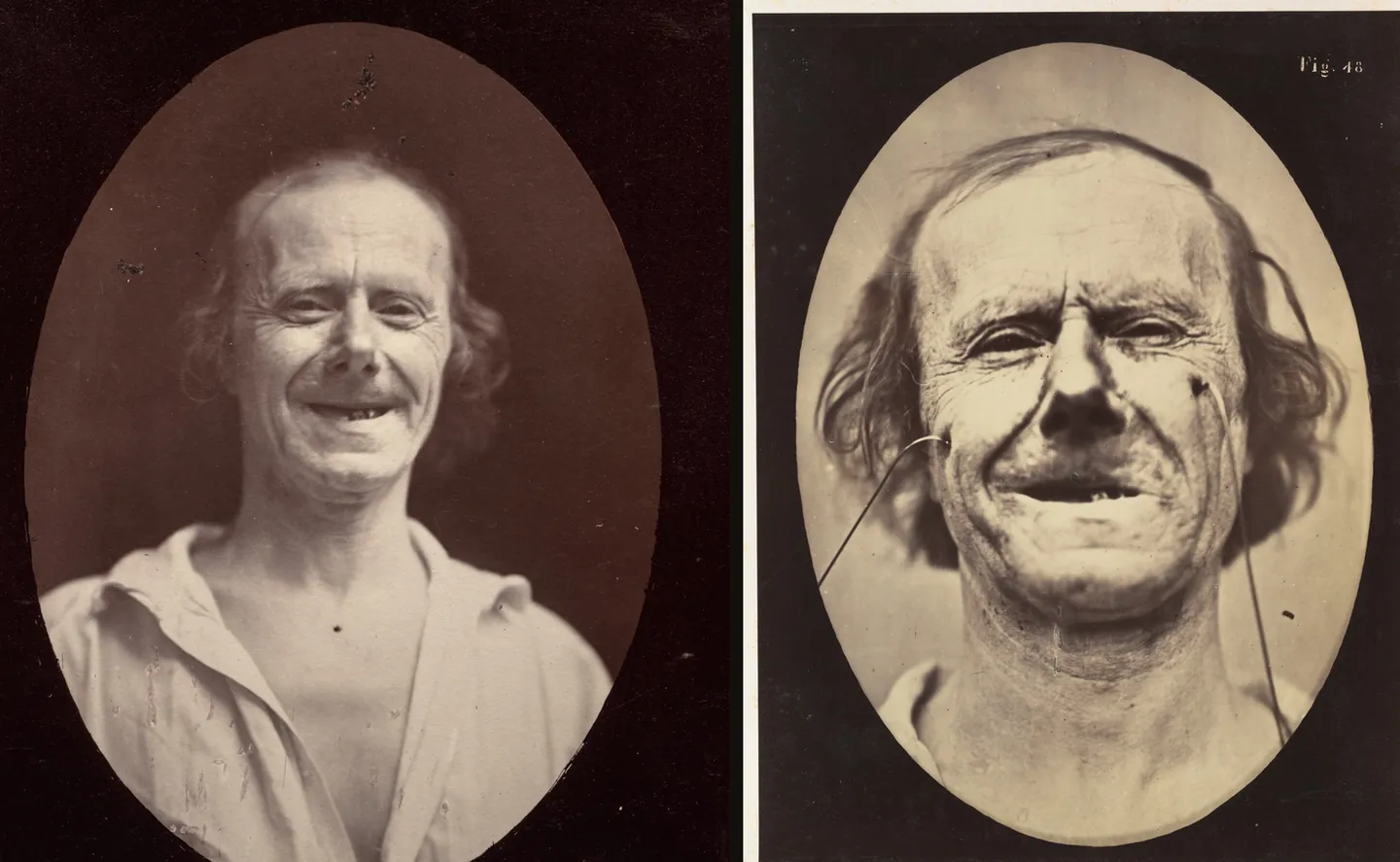
You have never seen a dragon fly, so any flight will do. You have seen thousands of people smile, lie and give up. Get that wrong, and an alarm goes off. Even timing is enough. Masahiro Mori, the roboticist who named the uncanny valley, wrote that if you slow a robot’s smile to half speed, “instead of looking happy, its expression turns creepy.” In a story, behaviour is the timing.
Any world works
If the world mattered most, original worlds would win and familiar ones would lose. Put four stories side by side.
Game of Thrones is the clearest case. Viewers accepted dragons and an army of the dead for seven seasons. In the last one, what they couldn’t accept was people who stopped being themselves, like Daenerys burning a city that had already surrendered. Nearly 1.9 million people have signed a petition to remake the season. Nobody signs a petition because a dragon flies wrong.
Made in Abyss: the classroom on the wall
Made in Abyss, Akihito Tsukushi’s manga, has one of the strangest worlds I know. On an island there is a hole about a kilometre wide and more than twenty kilometres deep. A town called Orth lives on its rim, off the relics that come up. And the hole has one rule: going down is easy, coming back up hurts. Rise more than about ten metres inside it, and the Curse of the Abyss strikes. Near the top, it’s dizziness. Deeper down, it’s hallucinations, then bleeding, then losing your humanity.
That’s the strange part. Here is what makes it real.
Early in the anime, the children of the orphanage sit through a lesson. The blackboard is on one wall. The desks are fixed up the opposite wall, row above row, and the children climb rope ladders to get to their seats.
Nobody explains it. As far as I can find, the show never gives a reason, and it doesn’t need to. In a town that lives off a hole, children learn to climb the way other children learn to read.
All of Orth works like that:
- A delver’s rank is a depth. The colour of your whistle says how deep you may go and still come back. Riko, the twelve-year-old heroine, wears a red one: the first layer only.
- The orphans pay their way with relics they dig out of the first layer. The town’s power comes from relics too.
- The greatest delvers may one day make a Last Dive, past the point where anyone comes back human. It is a goodbye with no return.
- Even the dead go down. At a funeral, the ashes are scattered into the Abyss.
Tsukushi says that for everything he adds to the world, he works out “the reason why it exists here now.” I think of the result as a slope. In Orth, everything tilts toward the hole, and everyone has that slope in their legs. You don’t believe in the Curse because it was explained well. You believe in it because a whole town has arranged its life around it, down to where the children sit.
Natives and tourists
That gives a simple test for any character, in any world. Do they act like a native, or like a tourist?
A native gives themselves away in three ways:
- They don’t explain. Nobody in Orth says “the Curse strikes on the way up.” They just avoid climbing. A character who tells others what they all already know is a tourist reading the guidebook out loud.
- They are surprised by the right things. Frieren is an elf who has lived for over a thousand years, in about the most familiar fantasy world there is: her story starts after the Demon King is already dead. To her, the hero’s ten-year quest was a short trip. Only when he dies of old age does she realise how little she knew him. That is what makes a familiar world feel new. Compare the crowd in so many fantasy stories that gasps when the hero does something ordinary. Tourists, all of them.
- They pay the price without being asked. On the desert planet of Dune, the Fremen walk without rhythm so the sandworms won’t come, and spitting on a table is an honour: a gift of water. Nobody stops to explain. It is in their manners.
Here is the difference in the world I use in every post: a kingdom built over the sealed body of a Demon King, where every spell burns a shard of mana dug out of him. You are the lowest-ranked adventurer in the guild, on your first morning in the mine.
The native is shorter and tells you more. The walls knock. Spells are expensive. The miner is poor. Nobody said any of it.
AI characters arrive as tourists
An AI character meets your world the way a tourist meets a city: through the guidebook. It reads your whole setting at once and starts talking. It knows every rule and has lived none of them. So it explains the world to people who live there, gasps at your ordinary spell, and sounds like a polite assistant under every accent, as I wrote in the post on soulless characters.
We can’t give an AI character forty years in a mine. We can give it a native’s knowledge and habits. In Dai Novel, that comes down to three fields and one rule:
- Knowledge, written from where they stand. The docs ask you to write it from near to far: their own street, its prices, debts and dangers; then their trade; then the wider world as it reaches them; then rumours, and places they’ve never been. The docs’ example is a dockworker who has only ever seen magic used by temple healers. That one line tells you exactly what would shock him.
- Persona, for the body. Habits, not adjectives. Not “careful”, but “knocks twice on every wall before she swings”.
- Back Story, for the reason. The wall that came down on floor one, and who was under it.
- No guidebook. In play, characters never see your premise or its secrets: only who they are, what they have lived through, and their Knowledge. And each one takes a turn of their own. The miner was digging before you came. He will be digging after you leave.
One question to take home
Ask one of your characters about their morning. A tourist describes the world. A native complains about the stairs.
Any world can work: a hole in the earth, a kingdom after the Demon King, a desert where spit is a gift. The people make it real, one habit at a time.
Give your people a slope
Write a world with one rule that costs something every day, and people who have lived with it for years. Or play someone else’s world, and see who complains about the stairs.
Create a world or play someone else’s