
Essay
Soulless characters: why one mind can’t play a whole town.
In many AI stories, the people around you know things they shouldn’t, stop living when you leave, and all sound the same. Why that happens, and how we fixed it.
Here’s a scene from the world I use in every post. You play an F-rank adventurer, the lowest rank in the guild, digging up mana shards to pay for your little brother’s medicine.
One evening, in a dark corner of the guild hall, you whisper to a stranger: near a crack on floor one, the shards are warm.
Next morning, the guild master greets you. “Warm shards, is it?”
He was across a loud room. He couldn’t have heard. The receptionist talks exactly like him, calm and kind. The stranger is gone. He only existed while you were talking to him.
The writing is fine. But nobody in that scene is anybody. They are soulless:
- They know things they couldn’t know.
- They only live while you are looking.
- They all sound like one person, and all of them live for you.
How great writers do it
Writers have dealt with this for centuries. Two examples I love.
Give them their own story. In Hamlet, Rosencrantz and Guildenstern are two courtiers so alike that the king and queen thank them in either order. In 1966, Tom Stoppard wrote a play where they are the leads: confused, scared, flipping coins, trying to work out why they were sent for. Hamlet only passes through. Same events, new lead, and two names become two people.
Give them their own errand. In William Faulkner’s As I Lay Dying (1930), a family carries their mother’s coffin to town to bury her. Fifteen people tell the story, one head per chapter. And almost everyone has a private reason for the trip. The father wants false teeth. The daughter needs a secret visit to the druggist. The youngest wants to see a toy train in a shop window.
The lesson is simple. Every character wants something that isn’t the hero. And every character knows only what they saw.
Why one AI can’t play everyone
Most AI story games use one model to write the whole scene: the narration and every character in it. One actor, many masks. Under the masks, it is still one mind:
- Same knowledge. It has read your thoughts, your whisper and every secret in the notes. You can’t make it forget, so everyone knows.
- Same personality. Chat models are trained to be calm, kind and helpful. So the cruel lord talks like a therapist, and the thief speaks in neat sentences.
- Same goal. It is writing a scene for you. So every character turns toward you, and nobody has an evening of their own.
Telling the model to “stay in character” helps a little. But one mind asked to be many still comes out as one mind.
Nobody sees everything
In Ryūnosuke Akutagawa’s short story “In a Grove” (1922), which Akira Kurosawa later filmed as Rashomon, a samurai is found dead in the woods. The bandit, the wife, and the dead man himself (through a medium) each tell what happened. All three say they did the killing. Each one tells the version they can live with.
Real people work like that. They see part of the story, and they see it through what they want. That is where secrets, mistakes and betrayals come from.
AI is bad at this. In 2023, researchers built a test called FANToM: conversations where people come and go, so some of them miss parts. Then they asked AI models who knew what. The best models did far worse than people.
If everyone knows everything, nothing can be hidden. And a story with no secrets is a dull story.
In Dai Novel, every character plays
So we stopped asking one writer to be everyone. In Dai Novel, every character a scene touches now plays the world the same way you do.
As a player, you say what you try, the world answers you, and you remember. Characters now get the same thing, in four steps every turn:
Step one even includes a small picture of how they look right now. If the story burned the guild master’s hand last week, he sees the bandage.
Here is how the evening of the whisper really goes. Before you even arrive, the guild master makes a plan:
The tremors on floor one are getting worse, and the floor is sold at the end of the month. Nobody goes down there until then. I close it tonight and tell no one why.
That is why floor one is closed when you get there. No shards, no medicine. That is why you end up in the corner with the stranger.
After the scene, the world tells the guild master what happened to him:
The F-rank asks you twice why floor one is closed. You give her nothing. An hour later she is in the corner with the stranger from the alley. You can’t hear them. You see her pass him something small that glows.
He didn’t hear your whisper. He only saw a glow. So he guesses, and he guesses wrong:
She’s selling to the alley because I shut the door on her. Better she owes the guild than him. At dawn, I offer her work on the upper floors, paid in medicine.
Next morning, he offers you a job. You didn’t plan any of this. You just walked into his story.
A memory that holds up
Each character keeps their last fifteen turns exactly as they happened. Older turns are folded into a short note on where they stand, like a player’s character sheet: hurt or not, money, debts, secrets. That note is checked against the world’s State Tracker, and when they disagree, the State Tracker wins. Then the old turns become memories in the character’s own voice.
And if you take a turn back, every character’s mind goes back with it. Nobody remembers a future that didn’t happen.
Everyone is the lead of their own story
Every character is told the same thing: this is your story, and the hero is a side character in it. So they choose what helps them, the way their nature does. A coward runs. A proud one saves face. Nobody gets nicer to make your evening easier.
It is Stoppard’s trick, done for everyone at once. And their plans go on off the page. The next day, the stranger isn’t in his corner. He went down to floor one in the night, through the crack you told him about.
It isn’t free. Each character thinks twice a turn, so turns are a little slower. Characters can be wrong on purpose, which sometimes feels like a bug. And passers-by stay passers-by. I think it is worth it.
You don’t live the world alone
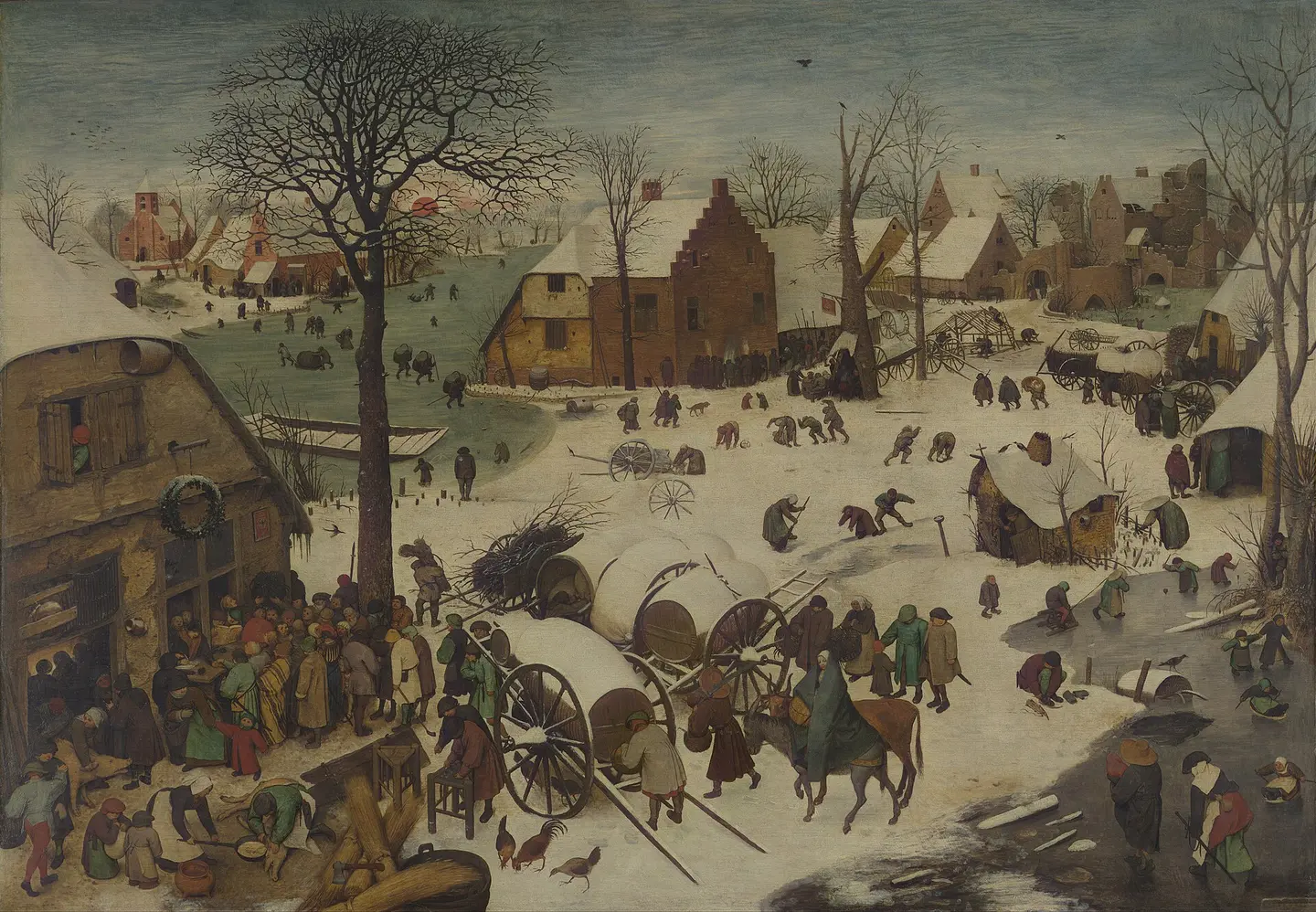
Look at Bruegel’s village again. The most famous story in the world is passing through, and nobody has noticed. Someone is killing a pig. Someone is paying a tax. Children are sliding on the ice. The painting feels full because everyone in it has a life.
That is what I want from a world you play. Your story is the one you came for. It isn’t the only one going on.
One question to take home: pick a side character in your story. What do they want tonight that has nothing to do with your hero?
If you can answer, they are somebody. With Dai Novel, you don’t live the world alone.
Meet the people who were there before you
Give every character something they want that has nothing to do with the hero. Or play a world someone else built, and find out whose story you just walked into.
Create a world or play someone else’s